There comes a moment when technology stops following the world—and begins to redefine it.
That moment is precisely where a new generation of deep-sea tourist submarines is emerging. Developed by the China Ship Scientific Research Centre, this ambitious project has the potential to transform the darkest depths of the ocean into the next frontier of luxury experience.
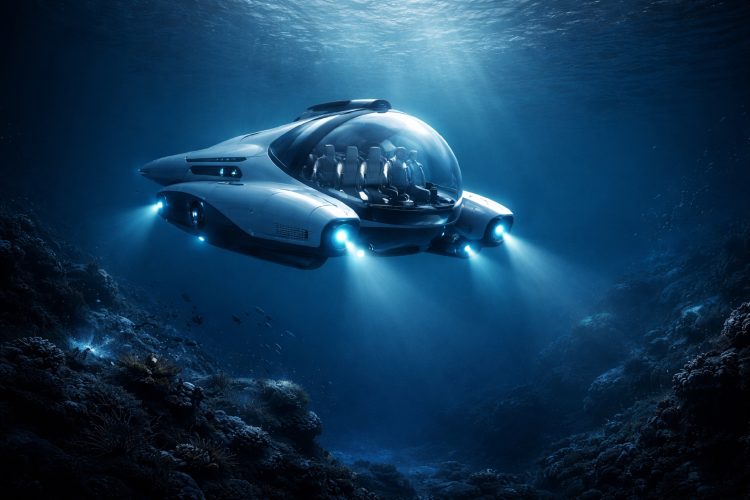
Designed to accommodate four people—including three passengers—the submarine is engineered to reach depths of up to 1,000 meters, a threshold beyond which the familiar world disappears. A prototype is expected by the end of 2026, with commercial deployment anticipated before 2030.
What sets this project apart is not only its ambition, but the fact that it has been in development for years, with many of the core engineering challenges already addressed on paper. At the center of the design lies its most critical feature—a panoramic viewport that allows passengers a direct gaze into the abyss. This element also represents the greatest technical challenge, as it must withstand pressure levels of approximately 100 atmospheres, characteristic of the bathypelagic zone.
At such depths, light vanishes, temperatures approach freezing, and the environment takes on an almost extraterrestrial quality. This is no longer traditional sightseeing—it is an encounter with the unknown. In that sense, the luxury offered by this submarine lies not in comfort alone, but in experience: the opportunity to access a realm previously reserved for scientists and explorers.
The panoramic window becomes more than a technical solution—it is an emotional bridge between humanity and the deep. Through it, passengers will experience something rarely accessible: silence, darkness, and the immense scale of the ocean.
Although often described as a tourism project, its potential is far more sophisticated. This submarine could evolve into a multifunctional platform—serving luxury cruise lines, exclusive resorts, scientific missions, and even documentary filmmaking. It is precisely this versatility that ensures its long-term viability, as deep-sea tourism remains a niche, yet symbolically powerful sector.
While pricing has not yet been disclosed, it is expected to be significantly lower than Western counterparts such as the U-Boat Worx Super Sub, which can reach approximately $5.5 million. This opens the door for a broader segment of the luxury market to access this new dimension of exploration.
The project arrives at a time when China continues to push the boundaries of industrial innovation. The vision of entrepreneur Richard Liu—focused on scaling luxury production into more accessible formats—signals a wider shift in the industry toward experiences that are both extraordinary and increasingly attainable.
While space continues to dominate headlines, the ocean remains the largest unexplored territory on Earth. And perhaps it is within that silence—far from light and noise—that the next great luxury spectacle lies.
By the end of this decade, descending into the depths may become a new benchmark of exclusivity—an experience for those ready to trade the horizon for the abyss, and the familiar for something far deeper, quieter, and infinitely more mysterious.