
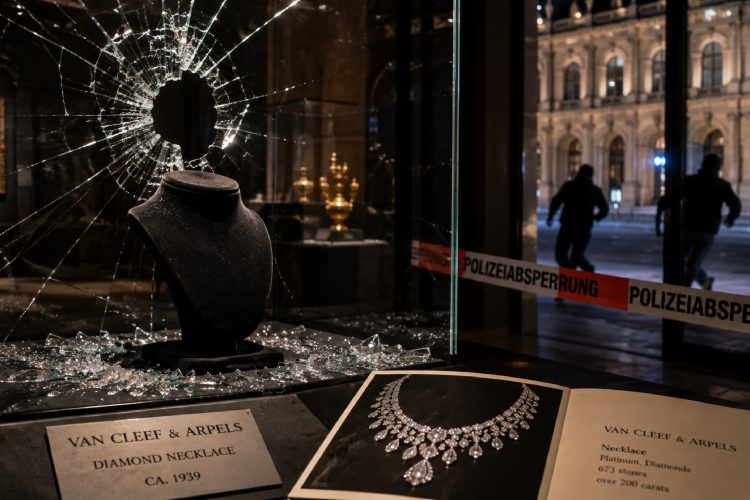
Two men entered a Vienna museum like perfectly ordinary visitors, bought tickets, walked up to a display case and – in the middle of opening hours – smashed the glass with a hammer.
Moments later, they disappeared with a historic Van Cleef & Arpels platinum and diamond necklace originally created for the Egyptian royal family and valued at at least $4.3 million. The spectacular theft has now triggered a major police manhunt, while Austrian media have reported one particularly intriguing theory: the robbery may have been commissioned by a criminal group from the Balkans.
The theft took place at MAK – the Museum of Applied Arts in Vienna – without sophisticated security hacking, masked specialists or the kind of elaborate plan one might expect from a Hollywood movie.
The suspects simply arrived during opening hours and bought tickets.
According to police, they were not even wearing masks, meaning surveillance cameras captured them clearly.
They then approached a display case containing one of the most valuable necklaces featured in the current Van Cleef & Arpels jewelry exhibition, smashed the glass with a hammer, took the piece and fled.
No one was injured in the incident.
673 Gemstones and More Than 200 Carats
What they took can hardly be described as an ordinary necklace.
The historic Van Cleef & Arpels piece is made of platinum and set with 673 gemstones weighing more than 200 carats in total.
The necklace was created for the Egyptian royal family and belonged to Queen Nazli of Egypt.
It secured a particularly important place in history in 1939, when the Queen wore it to the wedding of her daughter, Princess Fawzia, to Mohammad Reza Pahlavi, then Crown Prince of Iran and later the country’s last Shah.
In other words, the thieves did not simply steal diamonds.
They walked away with an object that had been a direct witness to one of the most glamorous royal events of the first half of the 20th century.
Its market value is hardly insignificant either. The necklace sold at Sotheby’s in New York in 2015 for an impressive $4.3 million.
Today, its value could potentially be even higher, although with an object of this kind, historical provenance is almost as important as the weight of its gemstones.
Stolen From an Exhibition of Almost 500 Objects
The necklace formed part of the exhibition Glanzstücke, which brings together Van Cleef & Arpels jewelry and objects from the MAK collection.
The exhibition includes approximately 500 pieces, more than 300 of them from the French jewelry Maison, while over 200 belong to the museum’s own collection.
The exhibition opened in June and was scheduled to run until September 27.
Following the robbery, however, the museum closed it until further notice.
While the police investigation continues, MAK has declined to release additional details about the incident.
Does the Trail Lead to the Balkans?
Vienna police have launched an extensive search for the two men and are carrying out a detailed analysis of security camera footage.
Austrian newspaper Kronen Zeitung, however, has reported a particularly interesting detail.
According to its information, investigators are considering the possibility that this was not an impulsive theft, but a targeted job commissioned by a criminal organization that may be based in the Balkans.
Austrian police have not publicly confirmed that theory, so it is important to stress that, for now, this remains a media report rather than an established fact.
Still, the nature of the stolen object raises an interesting question: what can a thief actually do with a necklace that is recognizable throughout the international jewelry world?
Selling it legally is virtually impossible. Auction houses, serious dealers and collectors would immediately recognize an object with such a thoroughly documented history.
In the worst-case scenario, that is precisely why there is a danger that the historic piece could be dismantled so that its individual diamonds can be sold more easily – permanently destroying an object of enormous cultural and historical importance.
Vienna Has Already Experienced a Spectacular Museum Theft
The Austrian capital has previous experience with robberies that sound as though they belong in a movie.
One of the most famous cases took place in 2003, when Benvenuto Cellini’s celebrated Saliera was stolen from the Kunsthistorisches Museum, a masterpiece of gold and enamel valued at approximately €50 million at the time.
The thief took advantage of construction scaffolding, climbed up to a window and entered the museum.
Unlike many major art thefts, however, that story eventually had a happy ending – the Saliera was recovered three years later.
After the Louvre, Now Vienna
The latest theft comes less than a year after the spectacular disappearance of French royal jewelry from the Louvre in Paris.
In October 2025, thieves broke into the Galerie d’Apollon and escaped with eight pieces of French Crown Jewels associated, among others, with Empress Eugénie and Queen Marie-Amélie.
The stolen objects were valued at approximately $102 million, although French officials emphasized that their historical value was effectively impossible to quantify.
The Vienna case now raises the same uncomfortable question once again for Europe’s greatest museums: how do you display jewelry worth millions while keeping it accessible enough for the public – yet inaccessible to thieves?
Because in this case, no months-long cinematic operation appears to have been necessary.
According to the information available so far, all it took was two men, two admission tickets and one hammer.
And somewhere outside the museum now sits a Van Cleef & Arpels necklace set with 673 gemstones, weighing more than 200 carats and carrying a royal history stretching back almost nine decades.