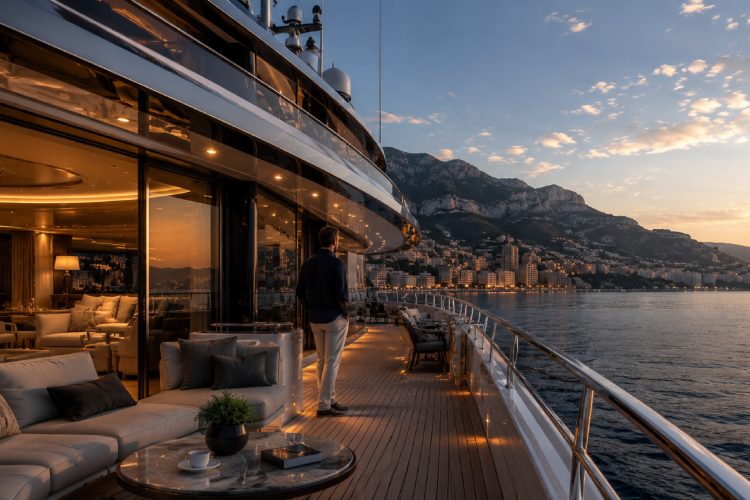
For decades, superyachts have represented one of the most striking symbols of wealth – floating palaces designed for summer vacations, parties in the Mediterranean and occasional escapes from everyday life.
However, among the world’s wealthiest individuals, an entirely different approach to life on the water is slowly emerging. For some owners, a yacht is no longer a second home. It is becoming the only home they truly need.
A growing number of wealthy owners are spending most of the year, and sometimes practically the entire year, aboard their yachts. Instead of a villa on the French Riviera, an apartment in London or a house in Florida, they are choosing a residence capable of changing countries, climates and views whenever they wish.
The development of satellite internet, more efficient propulsion systems, stabilizers and modern energy and water production systems has transformed what was once a complicated experiment into a far more realistic way of life. The consequences are already visible in shipyards: new superyachts are increasingly being designed not as vessels for a few weeks of vacation, but as luxury properties capable of traveling the world.
The Pandemic Changed the Way Owners See Their Yachts
According to Erwin Bamps, CEO of Gulf Craft, one of the largest yacht manufacturers in the Middle East, an important turning point came during the pandemic.
Many wealthy buyers purchased vessels at the time to gain privacy and freedom during a period when movement was restricted. But once the world returned to normal, some of them had no desire to give up life on the water.
What began as a temporary refuge evolved into a new lifestyle.
At the same time, the priorities of a new generation of wealthy owners have changed. Work-life balance, experiences, mobility and freedom are becoming more important than owning yet another static property.
One Majesty 112 owner, who spends most of his time aboard with his family while moving between marinas, says he has been running his business remotely for years. With almost all business activities taking place online, a physical presence in the office is no longer essential.
And when he wants to live in another country, he does not need to purchase another property or move house.
He simply raises the anchor.
Starlink Has Changed the Rules of Life at Sea
One of the greatest challenges of spending extended periods aboard a yacht used to be staying connected to the rest of the world.
Today, satellite internet services such as SpaceX’s Starlink provide reliable connectivity even at sea, allowing owners to hold video conferences, manage companies, monitor financial markets or simply watch Netflix almost as easily as they would from home.
At the same time, modern marine technology provides greater autonomy and more efficient fuel consumption, expanding the range of destinations yachts can reach without complicated logistics.
It is precisely this combination of mobility and connectivity that makes the lifestyle possible.
A house can provide comfort, but it cannot wake up in Monaco one morning, move to Greece a few weeks later and then cross to another continent together with its owner.
Owners No Longer Want a Boat – They Want a Home on the Water
The changing way yachts are being used is also transforming the way they are designed.
Bamps notes that today’s buyers demand stabilization systems that virtually eliminate the sensation of rolling, hybrid propulsion for quieter cruising without unpleasant fumes, enormous windows, powerful air conditioning and flawless internet connectivity.
In other words, they do not want to be constantly reminded that they are living aboard a boat.
They want the comfort of a luxury villa – only on the water.
For shipyards, that requires an entirely different approach. Storage spaces, kitchens, wardrobes, energy systems, freshwater capacity, waste management and privacy all have to be designed for months of continuous use rather than a few weeks during the summer season.
Leviathan Shows Just How Far the Concept Can Go
At the extreme end of this trend is Leviathan, a gigantic yacht measuring approximately 111 meters, built by Oceanco for billionaire and video game developer Gabe Newell.
Newell, best known as one of the founders of Valve, has gone far beyond simply spending the occasional extended period at sea. According to Newell himself, apart from a few months in 2021, he has effectively been living aboard vessels continuously since the pandemic.
His floating home therefore has little in common with the traditional concept of a yacht.
Among other features, Leviathan has a basketball court and a diving center, while the entire project was designed around its owner’s lifestyle rather than purely representational luxury.
In 2025, Newell even acquired Dutch shipyard Oceanco while simultaneously developing a fleet of research vessels, meaning that in his case, the boundaries between private residence, yacht and ocean research platform have almost completely disappeared.
A Sauna Instead of a Guest Cabin
Not every floating residence, however, needs to be a 111-meter gigayacht.
The transformation is also visible aboard smaller semi-custom models produced by Gulf Craft.
The owner of a Majesty 100 Terrace, who spends much of his time in Turkey, wanted his yacht to feel as much like a real home as possible. As a result, one of the guest cabins was sacrificed to make room for an infrared sauna.
During the colder months, it became an important part of everyday life aboard the yacht.
Requests like these demonstrate just how much the design philosophy has changed. A guest cabin that would make perfect sense aboard a yacht intended for charter or occasional vacations becomes less important when the owner lives aboard for months at a time.
The priority is no longer how many people can sleep aboard, but how the owner wants to live every single day.
Wardrobes Are Getting Bigger – And Even Ovens Can Become a Problem
Turning a yacht into a home also creates an entire range of unexpected challenges.
Gulf Craft has had to enlarge wardrobes so owners can keep their entire clothing collections aboard, while also finding ways to display artworks, sculptures and favorite possessions that would ordinarily be found in their villas.
Even kitchen appliances have become a serious consideration.
One owner complained that the cakes she baked aboard her yacht were not turning out properly, forcing the shipyard to reconsider the specifications of the oven.
At first glance, it sounds like a trivial problem, but it perfectly illustrates the difference between a vacation yacht and a yacht that serves as a permanent home.
When you spend two weeks a year aboard, you adapt to the yacht. When you live there, you expect the yacht to adapt to you.
Even an Ordinary Blender Can Complicate Yacht Design
Adding domestic comforts to a yacht is not as simple as it is in a conventional property.
Every additional refrigerator, microwave, blender, sauna or other electrical appliance increases overall energy consumption. That requires more powerful generators and larger battery systems, yet the physical dimensions of the yacht remain unchanged.
Engineers therefore have to find room for increasingly complex infrastructure without sacrificing valuable space intended for owners and guests.
Then there is another issue rarely seen in glamorous photographs of superyachts – waste.
A family spending four weeks away from a marina can generate an enormous amount of garbage, meaning its storage and processing become part of serious engineering considerations.
Living on a Yacht Is Not an Endless Vacation
The romantic idea of enjoying morning coffee on deck also has a less glamorous side.
The owner of an Oyster 595, who is currently living aboard during a 16-month circumnavigation as part of the Oyster World Rally, points out that life at anchor requires constant attention.
The position of the anchor, changes in wind direction, the amount of room the boat has to swing, neighboring vessels and weather forecasts all become part of everyday thinking.
Then there is the management of water and energy supplies, regular maintenance and safety.
Sometimes, it is not even possible to prepare the meal you want because certain ingredients simply are not available.
Yet for owners who have embraced this lifestyle, these responsibilities represent a small price to pay for what they receive in return.
A morning can begin with sunrise over a completely deserted anchorage, the day can continue with sailing or exploring a new destination, and by the following week, the same home can offer an entirely different view.
Is the Future of Luxury Real Estate on the Water?
Bamps believes this is not a passing trend.
He is so convinced of the growth potential of the floating residence market that he has hired two former real estate agents to sell yachts using an approach more closely resembling the sale of luxury homes than traditional yacht brokerage.
And that decision may be one of the clearest indications of where the industry is heading.
The world’s wealthiest buyers already have access to almost every form of luxury. What is considerably more difficult to buy is the freedom to change the location of your own home practically whenever you wish.
A superyacht offers precisely that.
As a result, the future of the world’s most exclusive residences could look very different from what we are accustomed to. Instead of an address in London, New York, Dubai or Monaco, the new ultimate status symbol could be a home with no permanent address – and a horizon that changes every morning.