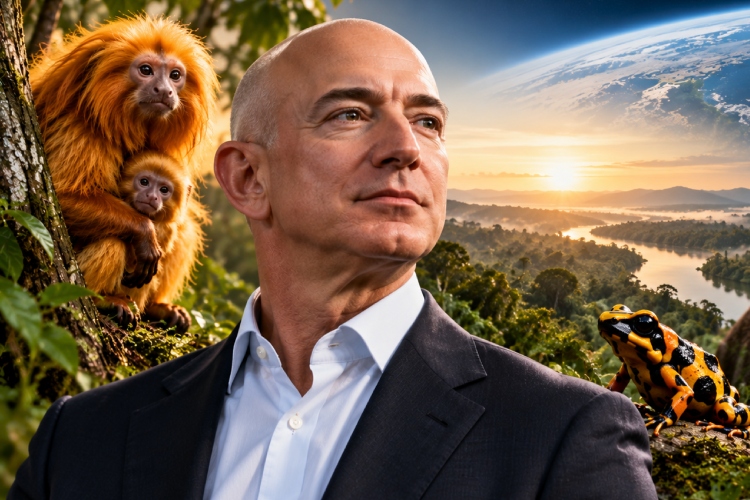
Some animal species on Earth have populations so small that more people have walked in space than there are surviving individuals of these species today. In an effort to prevent their complete disappearance, Jeff Bezos and eight other philanthropic organizations are joining forces in an initiative worth more than $500 million, dedicated to protecting the world's most endangered species.
While humanity invests billions of dollars in space exploration and the development of new technologies, certain animal species on Earth are approaching the very edge of extinction. Some have fewer than 50 surviving individuals, making their future extraordinarily uncertain.
In response to this growing crisis, the New Species Recovery Alliance was launched as a new international initiative announced during the United Nations Biodiversity Conference, COP17.
Nine private funders have committed more than $500 million over the next five years to preventing extinction and supporting the recovery of the world's most threatened plant and animal species.
Jeff Bezos and Leonardo DiCaprio Join Forces to Protect Wildlife
Among the organizations supporting the initiative is the Bezos Earth Fund, the philanthropic foundation led by Amazon founder Jeff Bezos, with Lauren Sánchez serving as vice chair.
The initiative also brings together Re:wild, an environmental organization associated with Hollywood actor Leonardo DiCaprio, alongside the Colossal Foundation, Critical Ecosystem Partnership Fund, Fondation Segré, Franklinia Foundation, Rainforest Trust, and WildLives Earth.
Their shared objective extends beyond simply financing conservation programs. The alliance aims to bring together scientific expertise, local partners, and targeted conservation measures capable of delivering meaningful long-term results.
According to Rainforest Trust, the initiative focuses on protecting more than 31,000 species across three categories of extinction risk.
Particular attention will be given to species whose populations have already declined so dramatically that their survival may depend on immediate intervention.
Some Animal Species Have Fewer Than 50 Surviving Individuals
Perhaps the most striking illustration of the global biodiversity crisis is the fact that certain species now have fewer than 50 individuals remaining in the wild.
Among the animals highlighted in connection with the initiative are the golden lion tamarin, the harlequin poison frog, and the lowland tapir.
The golden lion tamarin, a small primate instantly recognizable by its magnificent golden fur, has become one of Brazil's most recognizable symbols of endangered species conservation.
The harlequin frog faces an exceptionally high risk of extinction, while the lowland tapir represents another species whose long-term survival depends on protecting natural habitats and reducing threats to its population.
Although the level of endangerment varies considerably between species, they share an important challenge: protecting forests and establishing nature reserves is not always sufficient to guarantee their recovery.
For some species, survival requires more direct and carefully coordinated conservation efforts.
Why Protecting Natural Habitats Is No Longer Enough
Traditional biodiversity conservation programs have often focused on protecting extensive natural areas, including tropical rainforests, wetlands, and other important ecosystems.
However, conservation experts increasingly emphasize that certain species require much more targeted interventions.
These measures may include rebuilding depleted populations, protecting the last surviving individuals, improving breeding conditions, and establishing long-term partnerships with local communities.
As Cristian Samper, managing director and leader of Nature Solutions at the Bezos Earth Fund, has emphasized, protected areas alone cannot save every endangered species.
The New Species Recovery Alliance therefore aims to combine financial support with specialized recovery programs, while monitoring measurable conservation outcomes over the next five years.
Rather than relying exclusively on broad environmental protection strategies, the initiative seeks to address the specific challenges facing individual species and support solutions tailored to their survival.
Bezos Earth Fund Has Already Committed Billions to Protecting the Planet
The new initiative represents another chapter in the Bezos Earth Fund's extensive environmental commitments.
Jeff Bezos previously pledged a total of $10 billion to combat climate change and protect the environment, including $2 billion dedicated specifically to nature conservation and restoration.
In addition to participating in the new alliance, the Bezos Earth Fund announced a separate $100 million investment in August 2026, in partnership with Re:wild, to support the Phoenix Species Project.
Launched with the involvement of Leonardo DiCaprio, this program also focuses on protecting endangered species and helping threatened populations recover.
Together, these investments reflect the growing interest of major private philanthropic organizations in conservation initiatives that go beyond traditional habitat protection and directly address the threat of extinction.
They also highlight an evolving approach to environmental philanthropy, where financial resources are increasingly directed toward measurable outcomes and the long-term survival of vulnerable species.
More Than $500 Million to Give Endangered Species a Second Chance
Although a commitment exceeding half a billion dollars represents substantial financial support, the initiative's ultimate success will depend on how many threatened populations can be stabilized and restored.
For species whose entire remaining populations can be counted in dozens, every successful conservation intervention could prove decisive.
The New Species Recovery Alliance therefore represents an ambitious effort to unite private capital, scientific expertise, and local conservation programs around a shared objective: preventing the irreversible disappearance of some of the planet's most vulnerable forms of life.
At a time when humans are traveling into space with increasing frequency, the fact that certain species on Earth have fewer surviving individuals than the number of people who have performed spacewalks offers a powerful reminder of the scale of the biodiversity crisis.
The initiative supported by Jeff Bezos and other leading philanthropists could provide a crucial second chance for species that have reached the very brink of extinction.
Ultimately, preserving biodiversity is not simply about protecting individual animals or plants. It is about safeguarding the extraordinary complexity of life on Earth and ensuring that future generations inherit a planet where these remarkable species still exist.