What happens when a centuries-old tradition meets space technology? Scottish and Japanese scientists are preparing an extraordinary experiment that will send samples of Scotch whisky into orbit aboard a SpaceX rocket. The Space Puffin project aims to discover whether extreme temperature fluctuations in space could accelerate whisky maturation and potentially open an entirely new chapter in the production of one of the world's most celebrated spirits.
Producing exceptional Scotch whisky traditionally requires years, sometimes even decades, of patience. During maturation in oak barrels, the spirit gradually develops complex aromas, its characteristic color, and the distinctive depth of flavor that defines premium whisky.
However, scientists are now exploring whether conditions in Earth's orbit could influence this process and potentially accelerate it.
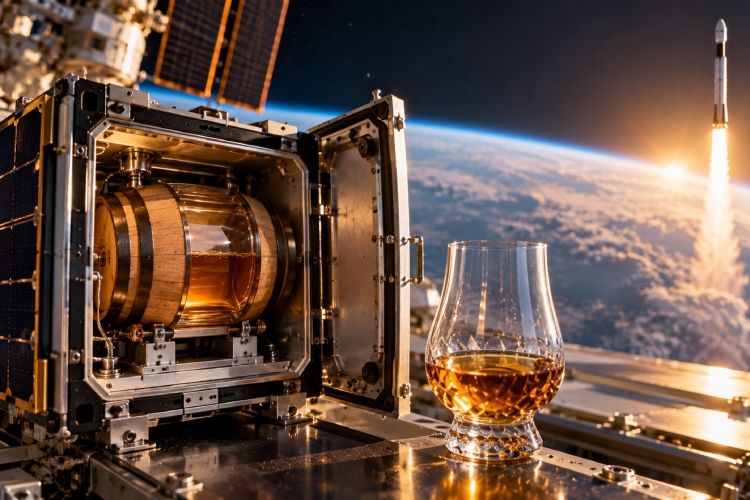
As part of the ambitious Space Puffin project, researchers plan to send just 10 milliliters of whisky into space, where specialized technology will monitor changes in its characteristics.
Although the quantity may be tiny, the scientific implications could be significant for an industry built around time, craftsmanship, and tradition.
Space Puffin: A Tiny Satellite with Extraordinary Ambitions
The experiment will be conducted using a miniature CubeSat satellite, jointly developed by Scottish and Japanese researchers.
Students from the University of Glasgow have already traveled to Japan to participate in designing the satellite that will carry the whisky samples and the equipment required for the research.
According to current plans, Space Puffin is scheduled to launch in 2028 as part of a SpaceX mission supplying the International Space Station.
After arriving at the station, the satellite will be deployed into orbit from the Japanese module.
The mission is conceived as a five-year experiment during which scientists will collect data on how the space environment affects whisky maturation.
By combining aerospace engineering with advanced chemical analysis, the project aims to investigate processes that have traditionally been studied almost exclusively in terrestrial warehouses.
For Scotland's renowned whisky industry, the findings could provide a completely new perspective on the relationship between environmental conditions and the development of flavor.
Could Space Accelerate the Whisky Maturation Process?
The central idea behind the research focuses on the temperature fluctuations experienced by a satellite as it orbits Earth.
Each orbit will take approximately 90 minutes, during which the spacecraft will alternate between periods of exposure to solar radiation and time spent in Earth's shadow.
Scientists want to determine whether these temperature cycles could influence the interaction between whisky and wood, potentially encouraging processes associated with the expansion and contraction of wood as temperatures change.
In traditional whisky warehouses, this interaction plays an important role in allowing the spirit to gradually absorb aromatic compounds from oak barrels.
Over time, these compounds contribute to the whisky's flavor, color, and overall complexity.
However, the space experiment does not guarantee faster maturation.
Its results will depend on the actual conditions inside the satellite, its thermal protection, and the way the whisky samples interact with the wood.
One of the project's most important objectives will therefore be to determine whether the orbital environment can produce measurable changes that could eventually prove useful to the traditional whisky industry.
Even if the experiment does not lead to a practical method of accelerating maturation, it could still provide valuable insights into the chemistry behind one of the world's most carefully controlled production processes.
An Artificial Tongue That Detects Flavor Differences with Over 99% Accuracy
One of the most fascinating aspects of the experiment is a technology known as the nanophotonic artificial tongue, developed by Dr. Alasdair Clark.
This instrument is designed to analyze the chemical characteristics of beverages and identify subtle differences associated with flavor and maturation.
According to the researchers, the technology can distinguish certain whisky characteristics with an accuracy exceeding 99 percent.
Thanks to this advanced system, scientists will be able to monitor changes in the samples without physically tasting them during the mission.
Instead of relying on conventional sensory analysis, the instrument will examine chemical signatures that can reveal how the whisky evolves under unusual environmental conditions.
The collected data could help researchers better understand the chemical processes responsible for whisky's distinctive character.
It could also reveal opportunities to apply some of these findings to production methods on Earth.
For an industry in which even subtle variations in aroma and flavor can influence the identity of a premium product, the ability to measure these changes with exceptional precision is particularly valuable.
Will We One Day Be Able to Buy Whisky Aged in Space?
Although the idea of luxury whisky matured in space sounds like the perfect foundation for an exclusive collector's edition, researchers emphasize that the Space Puffin project currently has no commercial objective.
Most importantly, the whisky samples involved in this mission will not return to Earth.
The satellite has not been designed for recovery, meaning the experiment will conclude with the collection of scientific data rather than the production of bottles that could be offered to collectors.
If the results suggest that orbital conditions positively influence the development of aromas, a future phase could involve developing systems capable of transporting larger quantities of whisky into space and safely returning them to Earth.
Only then would the possibility emerge of creating truly unique releases whose rarity, extraordinary origin, and unconventional maturation process could attract collectors of luxury spirits.
Such a product would undoubtedly occupy an unusual position within the world of premium whisky, where heritage, provenance, and distinctive production methods often contribute to a bottle's desirability.
For now, however, the prospect of commercially available space-aged Scotch whisky remains speculative.
Scotland's Traditional Whisky Industry Faces a New Frontier
Dr. Gilles Bailet, one of the scientists involved in the project, has explained that the research team hopes to understand how the space environment affects whisky aging while drawing on the accumulated knowledge of generations of Scottish whisky producers.
This is not the first time the alcoholic beverage industry has intersected with space exploration.
Budweiser previously sent barley seeds to the International Space Station to investigate how microgravity affects processes related to beer production.
Space Puffin, however, takes a different approach by focusing on one of the most important stages in the creation of exceptional whisky: maturation.
The project also highlights how scientific innovation can complement traditional craftsmanship rather than replace it.
While whisky production is deeply rooted in established methods, advances in analytical technology and environmental research may help producers gain a more detailed understanding of the complex transformations that occur inside oak barrels.
If the experiment succeeds, space may not replace Scotland's traditional maturation warehouses, but it could provide valuable new knowledge about how complex flavors and aromas develop.
And perhaps one day, the world's most exclusive whisky bottles will have a story that begins far above Earth's atmosphere.