In a world where luxury is measured in millions—and logistics becomes an art form when transporting rare icons like the Ferrari 250 GTO—scientists have taken things even further, pushing the limits of what is possible.
This time, it’s not about cars, but something far more valuable—and far more dangerous: antimatter. At CERN, a team of researchers achieved what once seemed unimaginable—transporting antimatter by truck. While it may sound almost ordinary, the reality is anything but. Antimatter is widely considered the most expensive substance on Earth, with estimates suggesting that producing just one gram would cost trillions of dollars. More importantly, when antimatter comes into contact with ordinary matter, both are instantly annihilated, releasing vast amounts of energy. This makes the achievement not just a technical challenge—but a scientific milestone.
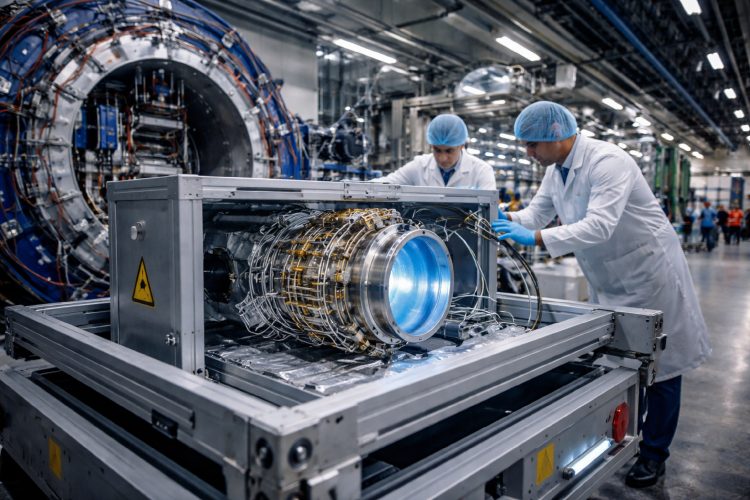
Using a specially designed portable system, scientists successfully trapped and transported just 92 antiprotons across the CERN complex. The number may seem almost symbolic, but in the realm of quantum physics, it represents a significant leap forward.
These particles were stored under conditions that mimic deep space: near-perfect vacuum and temperatures approaching absolute zero. Any vibration, temperature fluctuation, or contact with even the smallest amount of ordinary matter could result in their immediate destruction. The transport itself was carried out slowly and with extreme precision, making it one of the most delicate “shipments” in scientific history.
The importance of this experiment extends far beyond the demonstration of technological capability. By moving antimatter away from the accelerator environment, scientists can conduct more precise measurements, free from the interference that typically affects experiments.
At the heart of this research lies one of the greatest questions in science: why does the universe exist at all? According to prevailing theories, the Big Bang should have produced equal amounts of matter and antimatter, which would have annihilated each other completely. And yet, the universe as we know it survived. Understanding this imbalance could fundamentally reshape our knowledge of existence itself.
If transporting a luxury car is about preserving value, transporting antimatter is something far more extreme—it is about preserving existence. There is no margin for error. One wrong condition, and the “cargo” simply ceases to exist.
That is precisely why this moment matters. It represents a first step toward a future where antimatter can be studied with unprecedented precision—bringing us closer to answers that lie at the very foundation of reality.
And while the world of luxury continues to fascinate with price tags and exclusivity, science once again reminds us that some frontiers go far beyond even the most expensive objects—frontiers that challenge our understanding of the universe itself.