More photos
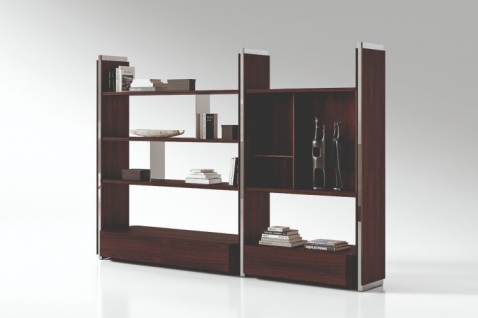
The boundary between furniture and architecture is becoming increasingly subtle, and the new Address bookcase by Cattelan Italia is a perfect example of this approach.
Designed as a freestanding modular system that develops around a vertical axis, Address is not conceived simply as a place to store books and decorative objects – it becomes an element capable of dividing, directing and visually transforming a space.
Designed by Paolo Cattelan, the system frees the traditional concept of a bookcase from the wall and transforms it into a lightweight, almost sculptural structure. Circular wooden shelves are arranged at different heights and can be rotated and individually oriented, meaning the final composition depends entirely on the space in which Address is installed.
It is precisely this freedom that allows the same system to look completely different in different interiors.
A Bookcase That Grows Like a Tree
The basic idea behind the Address system is reminiscent of the structure of a tree.
The shelves extend 360 degrees around a central vertical axis, while the modular construction allows for a wide variety of combinations. The height, position, rotation and direction of each individual surface can be selected during the design process, giving a classic piece of furniture an almost architectural level of flexibility.
Instead of a regular sequence of horizontal lines, the result is a composition filled with rhythm and movement. From one angle it can appear almost symmetrical, while from another the shelves overlap to create an entirely different silhouette.
From the Wall to the Center of the Room
Address does not have to be positioned against a wall.
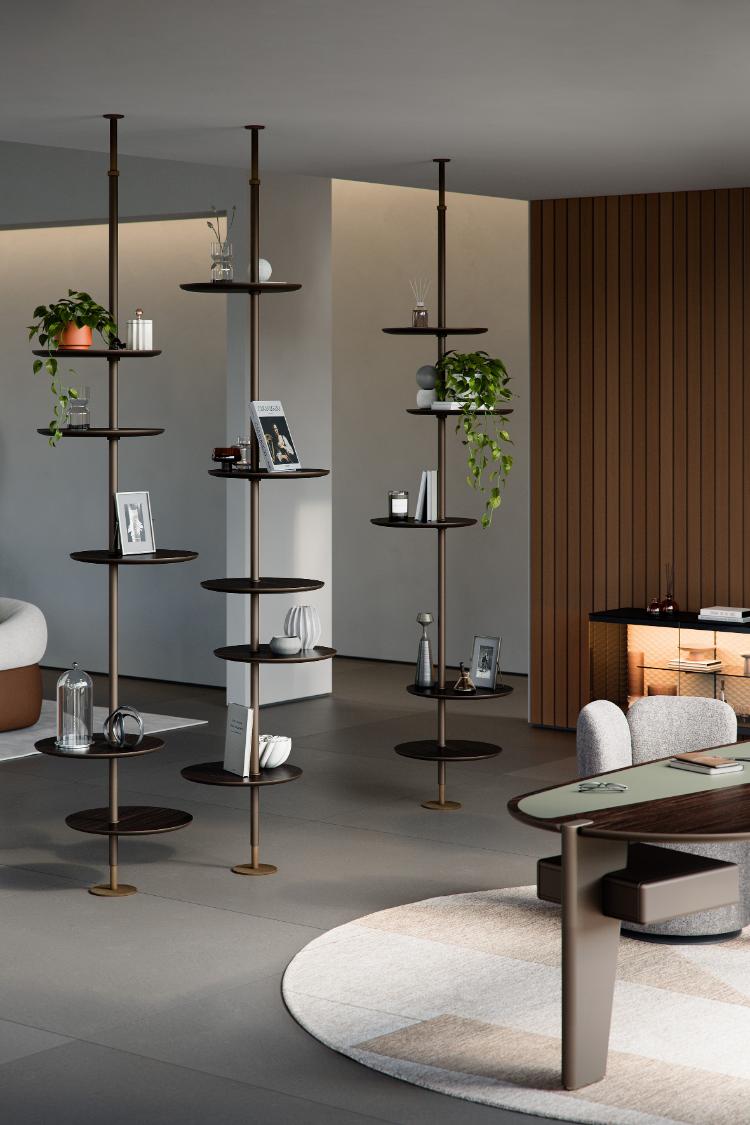
Thanks to its ceiling-mounted structure and freestanding concept, it can occupy a central position within a room and function as a subtle boundary between different areas.
This is particularly interesting in contemporary open-plan interiors, where there is often a need to define the living room, dining area, workspace or other functional zones without introducing conventional walls.
Address then becomes a kind of transparent partition – it divides without enclosing the space. Even a single module positioned away from the wall can function as a sculptural object, establishing a visual relationship with the surrounding furniture and architecture.
From Strict Symmetry to Controlled Chaos
The possibilities become even more interesting when several Address modules are combined.
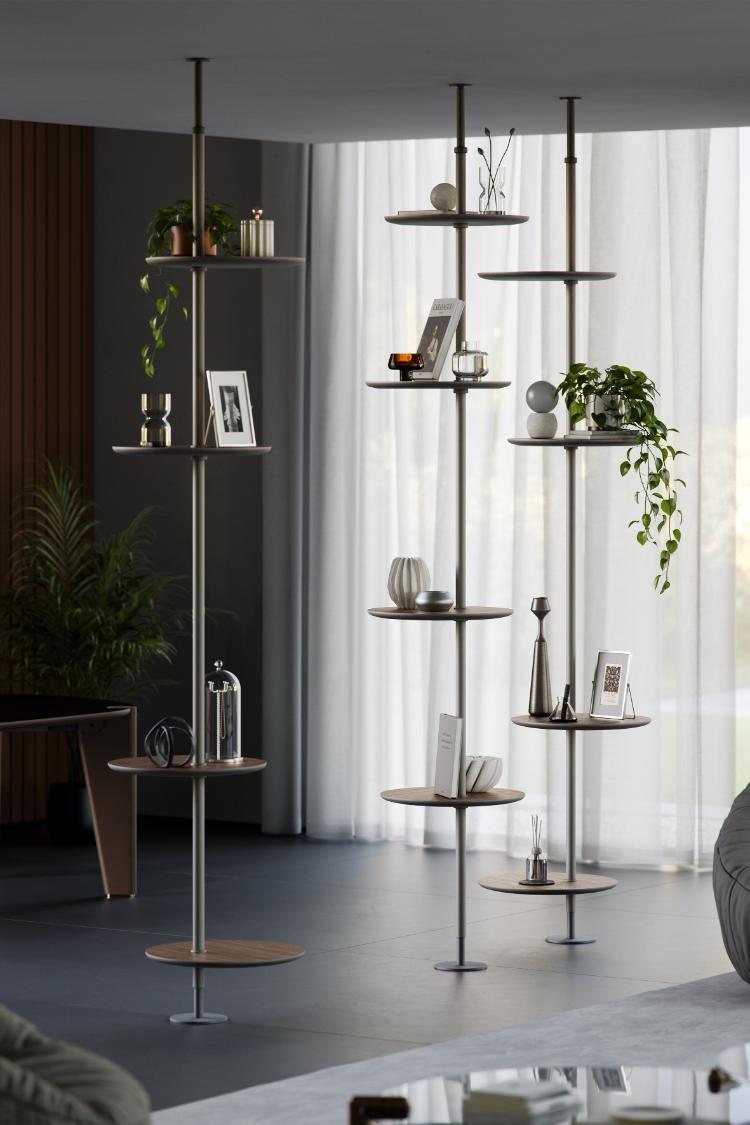
It is possible to create perfectly symmetrical compositions, spiral formations or much freer arrangements in which the shelves appear to be positioned almost randomly. Yet behind this visual “chaos” lies a carefully controlled sense of balance.
This flexibility allows interior designers to adapt the system to the architecture of a space rather than forcing the space to adapt to the furniture.
Fine Wood and Rounded Lines
In contrast to the strongly vertical structure, the shelves themselves feature soft, rounded forms.
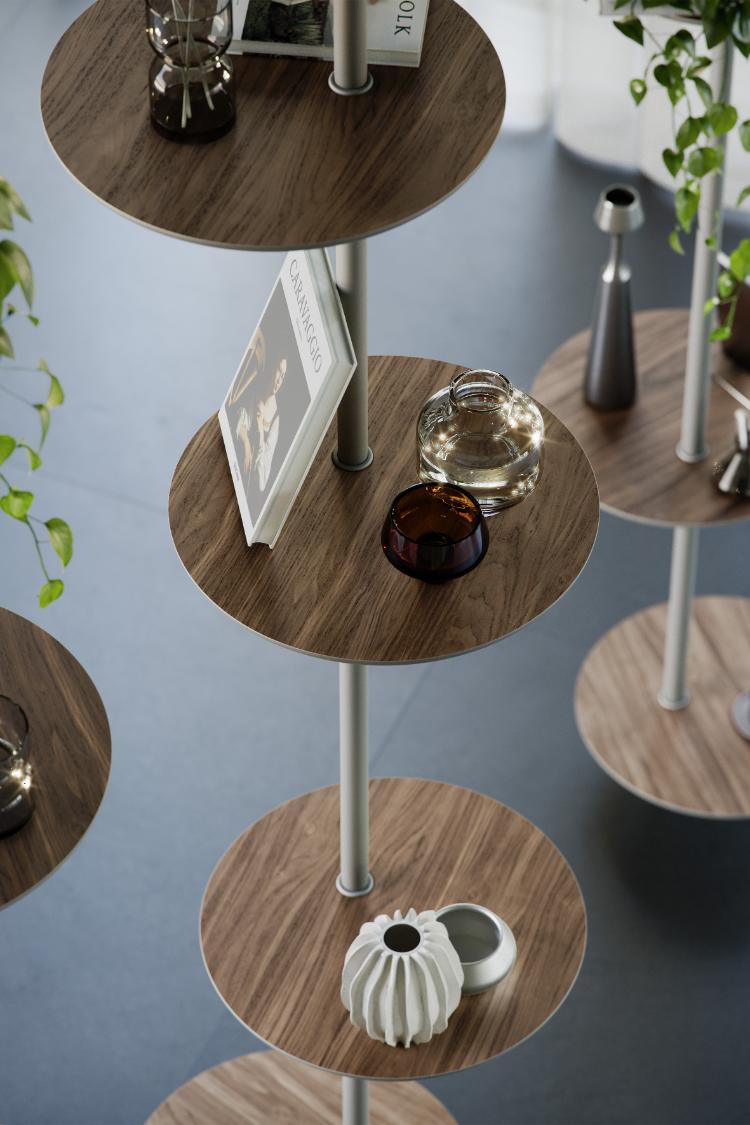
They are crafted as circular surfaces in fine wood and positioned at different heights along the central axis. Their lower edges are shaped with an elegant curve that gradually tapers toward the outside.
The visual result can also be seen in project photography: several slender vertical structures distributed throughout the room almost disappear into the interior, while circular shelves holding plants, books and decorative objects create the impression of objects floating in mid-air.
It is precisely the absence of massive side panels and conventional supports that makes Address appear considerably lighter than a traditional bookcase.
A New Way to Organize the Contemporary Home
Its modularity allows Address to adapt to walls and rooms of different dimensions, while its simple geometry enables the system to remain both functional and visually unobtrusive.
However, Address becomes most interesting when it is completely separated from the wall.
At that point, it stops being merely a place for books and decorative objects and becomes part of the architecture – an element capable of creating pathways, separating functional zones or simply becoming the sculptural focal point of a room.
With Address, Cattelan Italia offers a different interpretation of one of the most familiar pieces of furniture. Instead of a large bookcase occupying an entire wall, all that remains is a vertical line and several elegant wooden surfaces – enough to define a space without overwhelming it.