More photos
The boundary between furniture and architecture is becoming increasingly blurred, and the new Atlas collection by Minotti builds its entire identity around precisely that idea.
Designer Giampiero Tagliaferri has created a modular system for living and dining spaces in which substantial volumes, sophisticated surfaces, aluminum, wood, lacquer and stone come together in compositions that simultaneously provide storage, display favorite objects and define the surrounding space.
Minotti has long demonstrated that a piece of furniture does not have to be merely an object placed within a room. With the Atlas system, the Italian brand goes one step further, creating an element that effectively becomes part of the interior architecture itself.
Designed by Giampiero Tagliaferri, the collection was conceived as a modular open system and a family of storage units intended for living and dining areas.
Its shared visual language is defined by clean cuts, continuous lines and a combination of solid volumes with meticulously finished surfaces.
Aluminum Structure Becomes a Decorative Element
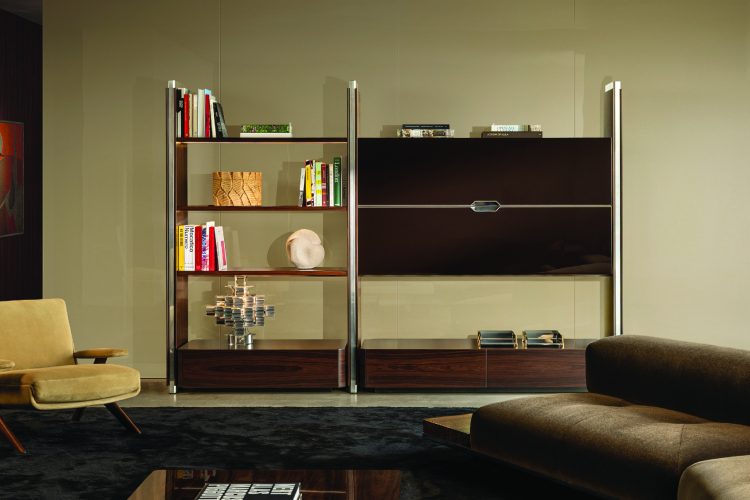
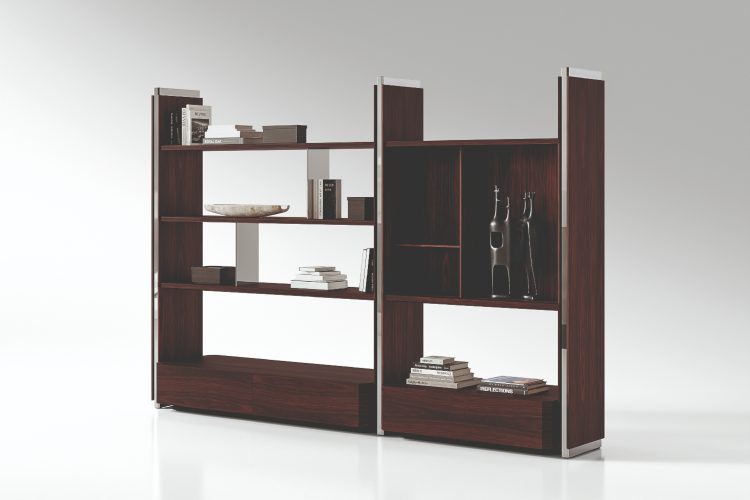
One of the details that makes Atlas immediately recognizable is its projecting structural side panels.
At their core is a polished aluminum profile with edges cut at a 45-degree angle. The structure extends all the way to the floor, where it ultimately takes on the function of a leg.
The side panels can then be clad in wood or high-gloss panels coordinated with the main volume of the unit.
Rather than attempting to conceal the structure, Minotti transforms it into one of the collection’s defining aesthetic features.
The result is a system with strong geometry that, despite its substantial visual presence, never feels heavy.
Shelves, Niches and Concealed Storage
Atlas was not conceived as a single predefined cabinet or shelving unit.
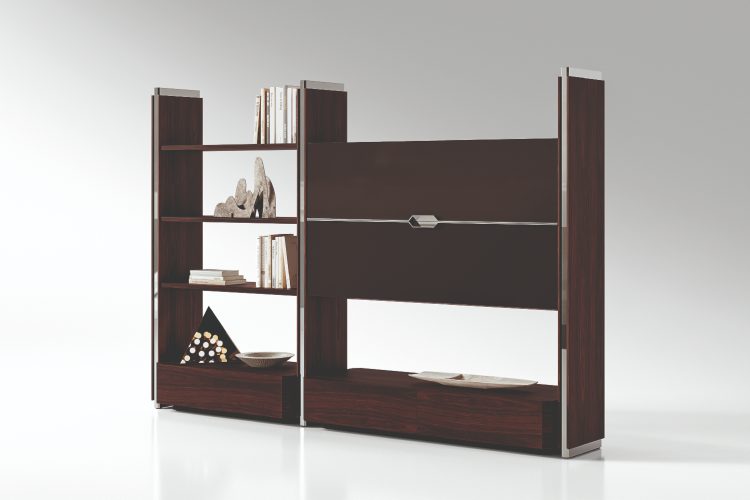
Its modular structure allows for a wide variety of configurations incorporating shelves, open niches and closed storage units, enabling the system to adapt to different spatial dimensions and functional requirements.
The lower section can incorporate a compartment with one or two drawers, featuring a discreet recessed groove used for opening them.
Suspended closed units feature an elongated diamond-shaped handle, while the interior reveals another luxurious detail – a reflective finish with a bronze-mirror effect.
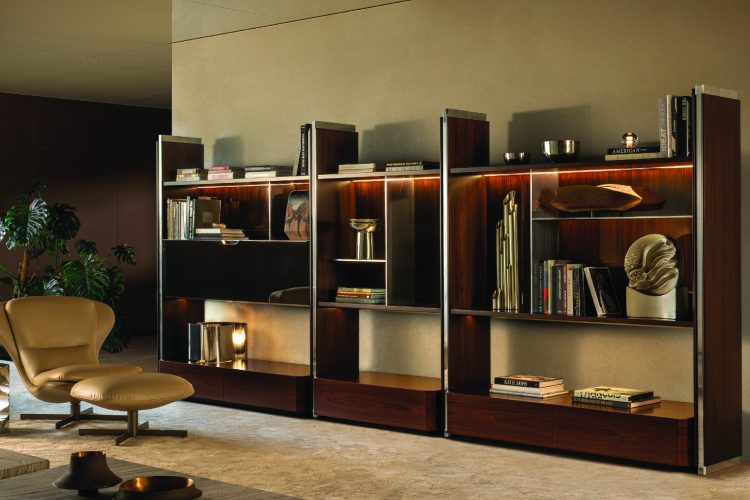
Open areas and niches are additionally equipped with an electrified lighting system with dimming functionality.
As a result, objects placed on the shelves no longer appear simply as things that needed somewhere to be stored. Lighting transforms them into part of the interior composition – from artworks and books to sculptures, vases and collectible pieces.
Atlas for Living and Dining Spaces
Minotti developed the system to respond to the different requirements of the contemporary home.
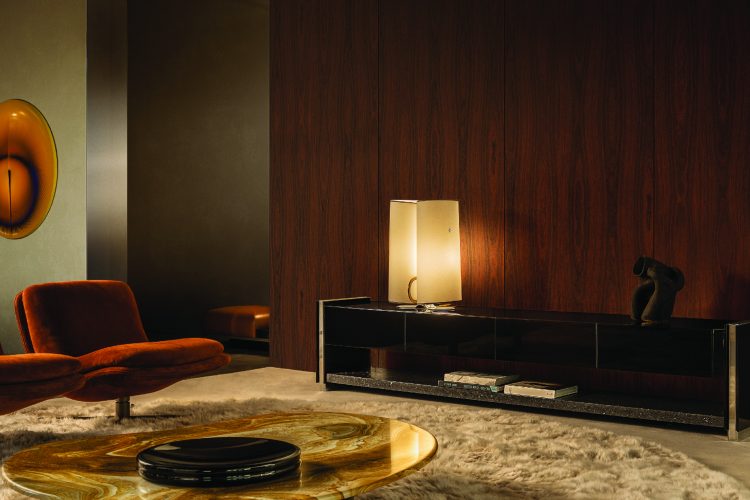
The storage unit designed for the living area is available in two sizes, with wood or high-gloss lacquer finishes and integrated drawers.
Its lower section incorporates an additional surface crafted from marble or stone, processed using a folding technique that creates the appearance of visual continuity.
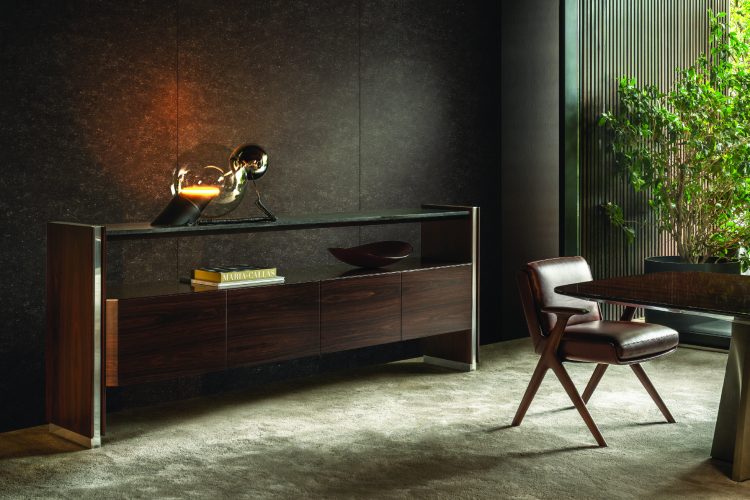
The Atlas family is completed by units designed for dining areas, also offered in two sizes and with the same selection of finishes.
Here, the central section conceals large drawers and a work surface, while the side panels extend beyond the main body to support an additional shelf. Function therefore becomes an integral part of the composition itself rather than a detail added as an afterthought.
Furniture That Organizes the Entire Interior
Modularity is precisely the greatest strength of the Atlas system.
It can remain a relatively discreet storage element, but it can also evolve into a much larger composition that visually organizes an entire wall and becomes one of the room’s main focal points.
Images presented in Minotti’s documentation demonstrate precisely this ability of the system to maintain the same recognizable design identity across different horizontal and vertical configurations.
Precise construction, a rich selection of materials, bronze reflective interiors and carefully controlled integrated lighting give Atlas a sense of luxury based not on decorative excess, but on the quality of its details.
At the same time, Minotti notes that the product also incorporates wooden components with FSC® certification.
Atlas is therefore particularly interesting as an example of how contemporary luxury furniture is evolving. Instead of an individual object that simply fills an empty space in a room, it becomes a flexible system designed together with the interior itself.
Minotti Atlas is not simply a place to store objects – it becomes an architectural line around which the entire space can be built.