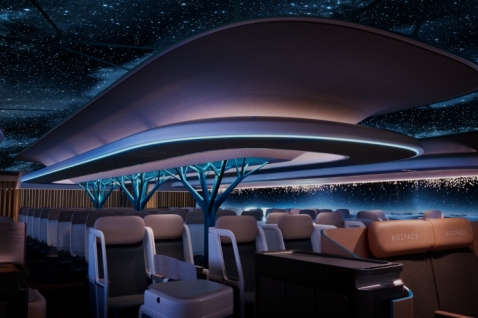
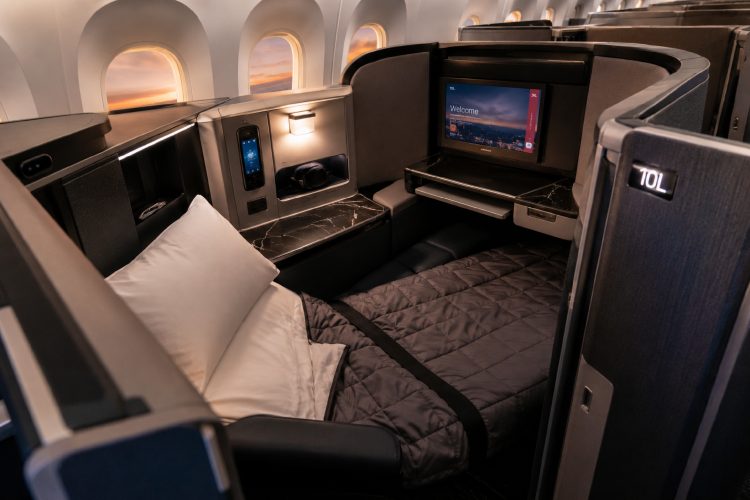
For years, there was one question that determined whether business class was really worth the money: could the seat convert into a completely flat bed?
Today, that is almost taken for granted. The new battle is being fought over every inch of private space, doors separating passengers from the rest of the cabin, enormous 4K screens, mattress pads, pajamas, mini-bars and meals created by celebrity chefs. American Airlines, United, Lufthansa, ANA and other carriers are now going one step further – dividing business class itself into standard and even more exclusive “business plus” categories.
First class is gradually disappearing from many commercial aircraft, but that does not mean luxury at 35,000 feet is becoming more modest.
Quite the opposite.
Airlines have found a new way to make the most expensive section of the aircraft even more expensive: they are creating a new hierarchy within business class itself.
It is no longer enough simply to buy a business-class ticket. Now you can pay extra to be – even among business-class passengers – in the first class of business class.
American Airlines Offers 42 Percent More Personal Space
A perfect example is the new Boeing 787-9 operated by American Airlines.
On flight AA86 between Chicago and London, there are eight special Flagship Suite Preferred suites located in a smaller, second business-class cabin.
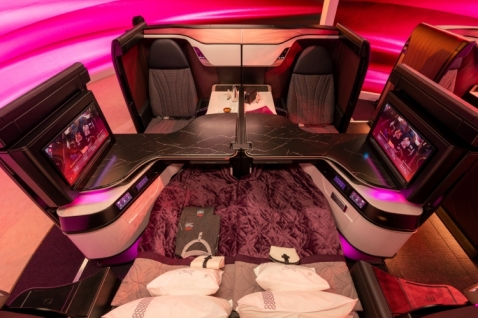
At first glance, they look similar to the standard Flagship Suite product: every passenger has direct aisle access, a sliding privacy door and a seat that converts into a fully flat bed.
The difference becomes much clearer once the door is closed.
The Preferred version offers 19 percent more sleeping space and as much as 42 percent more overall living space compared with the standard Flagship Suite.
There is more legroom, passengers can change sleeping positions more easily, and the additional space has not been devoted to one spectacular feature but distributed throughout the entire suite.
The seat also offers an intermediate lounging position between conventional seating and a fully flat bed.
There is a 17-inch 4K screen, wireless charging, Bluetooth connectivity and several separate storage compartments, along with more luxurious bedding, an additional mattress pad, pajamas and an upgraded amenity kit.
Even the console surface features a black marble-effect finish.
The idea is no longer simply to help passengers somehow sleep through an eight-hour flight to Europe. The cabin is designed to function as a small private space in which spending time actually feels pleasant.
Business Class Is Getting Its Own “First Class”
American Airlines is far from alone.
United has Polaris Studio, Air New Zealand offers Business Premier Luxe, while Lufthansa’s Allegris concept allows passengers to choose between several different seat types within the same business-class cabin.
That represents a significant change.
In the past, a business-class cabin generally featured identical seats, with the best position going to whoever booked it first.
Now, an airline can transform the most desirable seat into a separate product – and charge extra for it.
British Airways Proves It Isn’t All About Inches
British Airways made a major leap several years ago when it transitioned from its old Club World configuration to Club Suite.
On refurbished Boeing 777-200ER aircraft, passengers get a 1-2-1 layout, direct aisle access, a sliding door and a fully flat bed approximately 201 centimeters long.
There is also 40 percent more storage space than with the previous product.
But when most leading airlines already offer a good bed, a privacy door and a large screen, a new problem emerges:
How do you differentiate yourself from the competition?
The answer may once again be – people.
The quality of the cabin crew, the way dinner is served, attention to individual passengers and the ability to make service feel personalized without becoming intrusive are becoming just as important as seat specifications.
The best business-class product on paper does not necessarily deliver the best experience in the air.
United Puts a 27-Inch OLED TV in Front of Passengers
United has taken the “business plus” concept even further with its new Boeing 787-9 aircraft.
At the very front of the business-class cabin are eight Polaris Studio suites that are approximately 25 percent larger than standard Polaris seats.
They feature privacy doors and enormous 27-inch 4K OLED screens, while six of the suites also include an ottoman where a companion can sit.
Even the standard Polaris suites have been upgraded with doors and 19-inch 4K screens.
But United is not trying to beat its competitors with a bigger screen alone.
Dinner Is Now Created by Stars of Netflix’s Chef’s Table
Food is becoming the new battleground of luxury aviation.
Through a collaboration with Chef’s Table, United has introduced 11 menus created by chefs featured in the acclaimed Netflix series.
Nancy Silverton of Osteria Mozza in Los Angeles, for example, created a contemporary three-course Italian menu, while Tashi Gyamtso of Jimgu focused on local ingredients for his Japanese menu.
The selection depends on the city from which the flight departs, while the menus are expected to change seasonally beginning in October.
The logic is clear: if everyone can offer a bed, the next battle is over what you will eat in that bed – and who designed the menu.
Lufthansa Has Five Different Business-Class Seats
With its new Allegris cabin, Lufthansa has chosen perhaps the most complex approach.
Instead of offering a single product, passengers can choose between five different seat variants.
There is a front-row suite with a door, wardrobe and mini-bar, a separate version focused on privacy, as well as an option featuring an exceptionally long bed measuring more than 213 centimeters.
The partitions and doors are approximately 140 centimeters high, while the seats even offer heating and cooling functions, along with wireless charging and Bluetooth connectivity.
And then comes the detail that perhaps best explains this entire new trend:
Some of the more desirable positions require an additional payment.
In other words, buying a business-class ticket no longer necessarily marks the end of the upgrades.
ANA Creates a Seat More Than One Meter Wide
Japan’s ANA is taking a different approach – space.
The new The Room FX, developed for the Boeing 787-9, introduces 48 business-class seats with doors and an unusual sofa-like design.
Each suite features a 24-inch 4K screen, wireless charging, Bluetooth connectivity and additional storage space.
But the most impressive figure is the width.
The seat can measure as much as 41.5 inches, or approximately 105 centimeters wide – nearly twice the width of some competing products.
That means passengers can actually turn over naturally while sleeping, something that sounds trivial until you try to spend eight or ten hours asleep on an airplane.
The price of that comfort is a lower seat count in the cabin, particularly because the Boeing 787-9 is narrower than the 777 for which the original version of The Room was developed.
The first three aircraft equipped with The Room FX cabin are expected to enter service during 2026, with additional examples arriving in 2027.
How Much Privacy Are You Willing to Pay For?
And this is precisely where the essence of the new generation of business class lies.
Once, the greatest luxury was a seat that converted into a bed.
Then it became direct aisle access.
Then came the doors.
Now airlines are selling the space around the seat, additional privacy, better bedding, larger screens, longer beds, mini-bars, special menus and a few extra inches of personal space.
Business class is undergoing the same transformation that has already taken place across many luxury industries – a product stops feeling exclusive as soon as too many people have access to it.
So a new level appears above it.
For airlines, this is particularly attractive because space on an aircraft is some of the most expensive real estate in the world. Every additional inch given to one passenger is space that cannot be sold to someone else.
And that is precisely why the question defining the future of business class is no longer: “Does the seat turn into a bed?”
That was solved a long time ago.
Now the question is: how much space around that bed do you want entirely to yourself – and how much are you willing to pay for it?