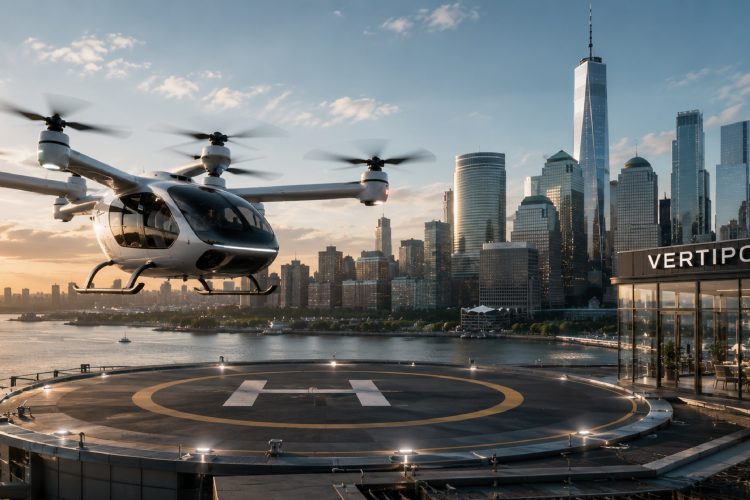
A decade after the first major promises that one day we would simply fly over urban traffic jams, electric air taxis are finally leaving the world of futuristic renderings and entering real airspace.
The first limited commercial flights could begin as early as 2026, while Joby Aviation, Archer, Wisk, Eve Air Mobility, Beta Technologies and Vertical Aerospace enter the final stage of the race. Still, do not expect skies filled with flying cars. The revolution will begin far more modestly – with short, expensive and tightly controlled flights between airports and city centers.
For years, eVTOL aircraft have been presented as the answer to one very simple question: if traffic on the ground is completely gridlocked, why not simply fly over it?
The idea gained particular momentum in 2016, when Uber Elevate unveiled its vision for the future of urban transport based on electric vertical take-off and landing aircraft.
They were supposed to be quieter than helicopters, produce no direct emissions during flight and eventually become affordable enough to function as a kind of Uber service in the sky.
What followed was a genuine technological frenzy.
Just a few years ago, more than 1,200 different eVTOL projects had been documented, with many manufacturers promising to carry passengers by 2025 or 2026.
Most of those promises never made it beyond PowerPoint presentations.
From 1,200 Ideas to a Handful of Serious Players
Many eVTOL startups raised capital, spent it and disappeared before ever producing a functional aircraft.
Even Uber abandoned its own project and sold Uber Elevate to Joby Aviation.
Today, the list of serious contenders is considerably shorter.
Among the companies closest to actual commercial operations are Joby Aviation, Archer, Wisk, Eve Air Mobility, Beta Technologies and Vertical Aerospace.
According to Mike Hirschberg, a longtime aviation consultant and former head of the Vertical Flight Society, the public should begin seeing the most advanced aircraft much more frequently on demonstration flights over the coming months.
And for the first time, there is a realistic possibility that passengers may soon be able to step aboard them as well.
Joby Could Be the First to Carry Passengers
One of the favorites in the race is Joby Aviation, which is currently among the most advanced companies in the certification process with the U.S. Federal Aviation Administration.
The first limited commercial service could begin as early as 2026, although it is still not entirely clear whether the historic first flights will take place in the United States or Dubai.
The process has also been accelerated by the U.S. eVTOL Integration Pilot Program (eIPP), established by executive order in June 2025. It allows companies with operational aircraft to conduct demonstration operations at selected locations even before receiving final FAA type certification.
That is an important step because proving that an eVTOL can fly is one thing.
Proving that it can transport people safely, reliably and every day above a major city is something else entirely.
These Won’t Be Long-Distance Aircraft – At Least Not at First
The first genuine applications of eVTOL aircraft will be far shorter than the futuristic visions once promised.
Instead of regional travel, the industry is increasingly focusing on so-called last-mile mobility – short urban routes where the aircraft solves precisely the part of a journey that can take forever by car.
Imagine, for example:
JFK – Manhattan.
Or Miami International Airport – downtown Miami.
LAX – Malibu.
A journey that can take an hour by car, or considerably longer during rush hour, could potentially be reduced to just a few minutes in the air.
Similar services could be particularly attractive during major events such as Formula 1 races, the Masters Tournament or the Kentucky Derby, when thousands of people are traveling toward the same destination at the same time.
The concept is particularly suited to airports, business districts, luxury resorts and major entertainment or sporting venues, where travelers may be willing to pay a premium to avoid traffic.
Before such services can operate at scale, however, cities will need regulations, infrastructure, vertiports, air traffic control procedures and an entire certification ecosystem.
Because the biggest challenge facing the eVTOL revolution is no longer building an aircraft capable of taking off.
The challenge is building a system in which hundreds of them can fly safely.
At First, This Will Be Transportation for the Wealthy
Although industry pioneers have spent years talking about democratizing air travel, the beginning will almost certainly look very different.
The first fleets will be small.
The number of routes will be limited.
And prices will be high.
That is why experts expect eVTOL services to be used primarily by wealthier travelers during the first phase – essentially the same audience that already pays for helicopter transfers to avoid spending hours trapped in city traffic.
Only once production increases, infrastructure expands and operating costs fall could air taxis become accessible to a much broader group of passengers.
In other words, the first iPhone was not a phone for everyone. The first Tesla was not a car for everyone either.
Flying taxis are unlikely to be any different.
A Trillion-Dollar Market?
Industry estimates are enormous.
SMG Consulting expects Joby to complete final certification within the next two years, while other leading manufacturers are expected to follow during the second half of the decade.
Real growth, however, may not begin until the 2030s.
Supply is expected to begin catching up with demand more seriously around the middle of the next decade, while the global market could reach a value of $1 trillion by 2050.
That, of course, is a long-term projection, and a great deal could still change.
Batteries need to improve. Manufacturing needs to become cheaper. Regulators need to be confident that the aircraft are safe. Cities need to find space for vertiports. Residents need to accept the idea of dozens or even hundreds of new aircraft flying above their heads.
And the industry still has to prove that the business model actually works.
Blade Runner Can Wait
Perhaps that is the biggest difference between the eVTOL industry of 2016 and the one emerging in 2026.
Ten years ago, it was selling a vision.
Today, it is facing a test of reality.
The first flying taxis will not transform cities overnight. There will not suddenly be thousands of aircraft above Manhattan, Dubai or Los Angeles, nor will we be ordering an air taxi from an app next year as casually as we summon a car today.
It will begin with a few aircraft.
A few routes.
A few minutes of flight.
And probably a fairly expensive ticket.
But after a decade of prototypes, billions of dollars in investment, failed companies and promises repeatedly pushed back by “another few years,” the flying taxi is finally no longer just a concept of the future.
Now comes the much harder part: proving that it can actually become transportation.