More photos
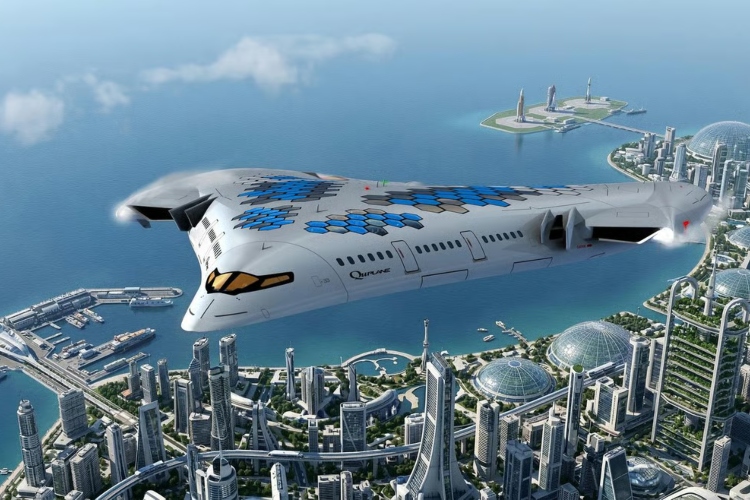
Imagine traveling from New York to London in just two hours while relaxing in a private suite complete with a comfortable bed, panoramic views, and the atmosphere of a luxury hotel. This is the future of air travel envisioned by QuPlane, a futuristic hydrogen-powered supersonic aircraft concept that combines the speed of the legendary Concorde with the comfort of private aviation and technologies that could transform the way we travel.
In a world where luxury travel increasingly revolves around privacy, personalized service, and saving valuable time, the QuPlane concept represents one of the most ambitious visions for the future of commercial aviation.
This extraordinary aircraft was conceived by Oscar Viñals, an industrial and conceptual designer from Barcelona known for his futuristic projects exploring the boundaries of modern aerospace technology.
His latest vision proposes a supersonic passenger aircraft capable of reaching Mach 2.1, accommodating up to 200 passengers, and covering approximately 16,000 kilometers without stopping.
However, unlike the legendary Concorde, whose cabin was relatively narrow despite its exceptional performance, QuPlane is envisioned as a luxury hotel above the clouds, complete with private suites, spacious seating, and intelligent systems that adapt to passengers' individual needs.
It is important to emphasize that QuPlane remains a conceptual project rather than an aircraft that has already been manufactured or tested.
Viñals places his vision within a potential development timeframe between 2040 and 2055, while no manufacturer, operating airline, or confirmed commercial launch date has been announced.
Supersonic Speed That Could Transform International Travel
One of the most ambitious promises of the QuPlane project concerns the dramatic reduction of travel times.
According to its designer's vision, the aircraft could reduce the duration of certain flights by as much as 70 percent, allowing journeys that currently take many hours to be completed in a fraction of the time.
The most striking example is the route between London and New York, for which a flight time of approximately two hours has been proposed.
For comparison, the legendary Concorde regularly crossed the Atlantic in around three and a half hours, traveling at approximately Mach 2.04.
Its fastest recorded flight from New York to London took just two hours, 52 minutes, and 59 seconds in February 1996.
According to the project's ambitions, QuPlane would offer slightly greater speed, a significantly longer range, and capacity for up to 200 passengers.
Its proposed range of approximately 16,000 kilometers could also make exceptionally long nonstop journeys possible, including certain routes between London and Australia.
However, the estimated two-hour transatlantic flight remains an ambitious target that has yet to be demonstrated.
A cruising speed of Mach 2.1 alone does not guarantee such a journey time, as the total duration would also depend on takeoff, acceleration, deceleration, flight routing, and airspace restrictions.
Nevertheless, the concept illustrates how future supersonic aviation could fundamentally change the relationship between distance and travel time.
Radical Design Without a Conventional Fuselage and Wings
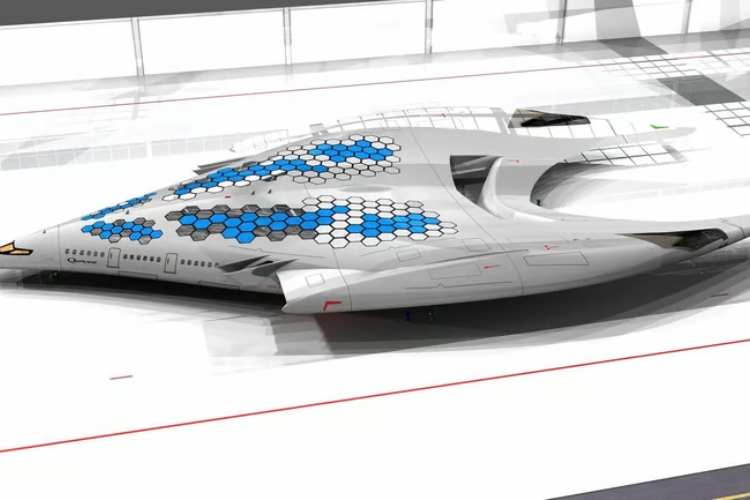
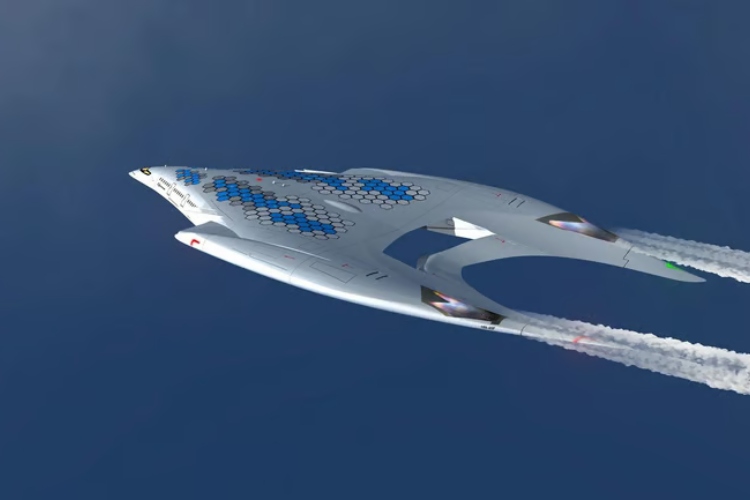
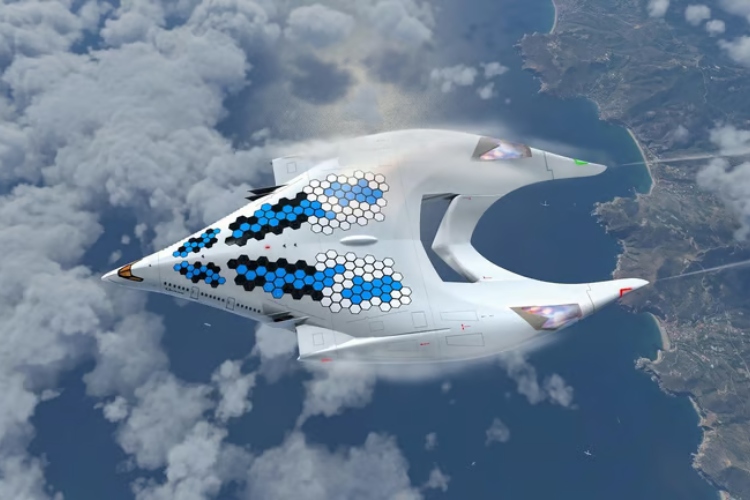
Unlike conventional passenger aircraft, QuPlane features an advanced Blended Wing Body configuration, in which the fuselage and wings merge into a single, broad aerodynamic structure.
Instead of the familiar cylindrical fuselage with clearly separated wings, the concept features a flattened, almost science-fiction-inspired silhouette resembling a flying wing.
According to the proposed specifications, the aircraft would measure 67.6 meters in length, with a wingspan of 34.9 meters and a height of just 5.3 meters.
This configuration is intended to improve aerodynamic efficiency while creating a significantly more flexible interior space for passengers.
The planned cruising altitude is approximately 18,000 meters, or 59,000 feet, considerably higher than the typical operating altitudes of today's commercial passenger aircraft.
The proposed maximum speed reaches Mach 2.2, while the projected maximum takeoff weight is approximately 440,000 kilograms.
These figures represent design objectives rather than verified performance specifications.
Achieving them would depend on the successful development and integration of numerous advanced technologies, many of which remain experimental.
The unconventional aircraft configuration would also require extensive aerodynamic testing, structural analysis, and certification before it could become a viable commercial product.
Hydrogen Propulsion as the Foundation of Future Aviation
One of the most significant features of QuPlane is its proposed use of liquid hydrogen as the primary fuel.
According to the concept, the aircraft would carry approximately 145,000 kilograms of liquid hydrogen stored in specially insulated tanks constructed from composite materials.
These tanks would feature double walls and vacuum insulation, maintaining the fuel at a temperature of approximately minus 253 degrees Celsius.
Such extreme conditions are necessary for storing liquid hydrogen, but they also represent one of the project's greatest technical challenges.
Hydrogen would serve a dual purpose.
In addition to powering the propulsion system, its extremely low temperature could be used to cool certain engine components before combustion.
The proposed propulsion architecture incorporates four combined-cycle turbine engines, rotating detonation technology, and electromagnetic airflow management.
Additionally, the system would capture hydrogen evaporating from the storage tanks and use it in auxiliary fuel cells to generate electricity for onboard equipment.
Although hydrogen has the potential to reduce carbon dioxide emissions during flight, its overall environmental impact would depend on how the fuel is produced, the energy required for its production and storage, and other emissions associated with aircraft operation.
The concept therefore represents an ambitious exploration of alternative aviation propulsion rather than a proven solution to the environmental challenges of supersonic flight.
A Compact Fusion Reactor: The Project's Most Ambitious Technology
QuPlane's technological ambitions extend far beyond hydrogen propulsion.
The designer also envisions the possibility of integrating a compact fusion reactor capable of generating between 80 and 150 megawatts of electrical power.
This system would be complemented by technologies designed to harvest energy from the aircraft's surface, creating an exceptionally complex onboard energy architecture.
However, this is also one of the most uncertain aspects of the entire concept.
Compact fusion reactors with the required characteristics are not currently available for practical use in passenger aircraft.
Integrating such a system would raise enormous questions concerning weight, safety, cooling, shielding, and aviation certification.
For this reason, Viñals has also proposed an alternative configuration relying exclusively on hydrogen propulsion if fusion technology does not advance quickly enough.
It remains unknown how such a change would affect the aircraft's proposed range, speed, and overall performance.
While the inclusion of fusion technology gives QuPlane an unmistakably futuristic identity, its realization would require breakthroughs extending well beyond the current capabilities of commercial aviation.
Private Suites Instead of Traditional First Class
Although the technical specifications are impressive, the interior is likely to attract the greatest attention from enthusiasts of luxury travel.
Unlike Concorde, whose passenger cabin was relatively compact, QuPlane is envisioned as an aircraft offering significantly more space and privacy.
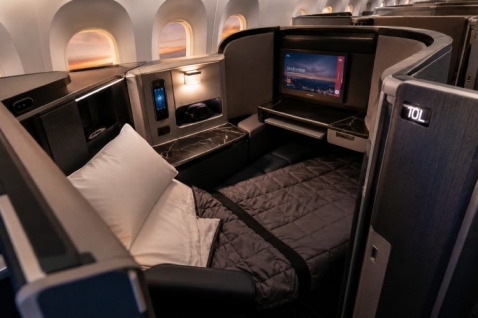
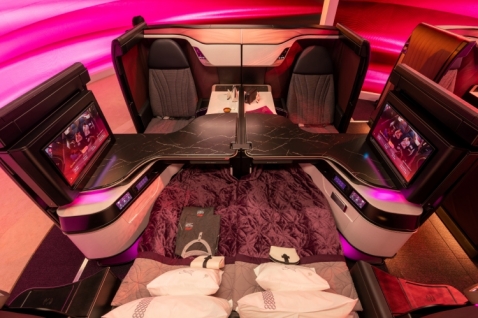
The most exclusive section of the cabin would feature Quantum Suites, private accommodations designed for first-class passengers.
These suites are conceived as completely separated rooms with floor-to-ceiling partitions, comfortable relaxation areas, and beds measuring approximately 190 centimeters in length.
Instead of a traditional airline seat that converts into a flat bed, the concept proposes an experience more closely resembling a private hotel room.
Passengers would be able to rest, work, or enjoy complete privacy during their journey without constant interaction with the rest of the cabin.
The design reflects a growing emphasis on personal space in luxury aviation, where comfort is increasingly defined not only by premium materials and exceptional service but also by the ability to create a private environment.
Although the final number and arrangement of suites have not been disclosed, the concept clearly demonstrates an ambition to elevate supersonic travel to an entirely new level of luxury.
More Space in Business and Economy Class
QuPlane would not be designed exclusively for first-class travelers.
The concept proposes three passenger categories, with improved comfort throughout the cabin.
In business class, the traditional middle seat would be eliminated, giving passengers more personal space and easier access to the aisles.
Passengers in the standard cabin would enjoy seats approximately 48 centimeters, or 19 inches, wide.
This would be around five centimeters wider than the average seat width cited for certain contemporary economy-class cabins.
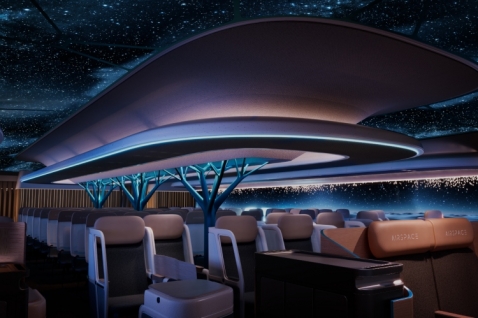
Additional features include vibration-reducing seating, increased cabin height, panoramic viewing surfaces, and advanced noise-reduction technologies.
The objective is to create a calm and comfortable environment even while traveling at supersonic speeds, moving away from the relatively confined experience traditionally associated with exceptionally fast aircraft.
By incorporating comfort-focused design across all three cabin categories, QuPlane attempts to combine the performance of a supersonic aircraft with the passenger experience expected from modern premium long-haul aviation.
Artificial Intelligence as a Personal Concierge at 18,000 Meters
QuPlane also envisions an advanced artificial intelligence-based cabin management system.
Known as the AI Quantum Hospitality System, this technology would continuously adjust lighting, temperature, and humidity throughout the aircraft.
The idea is to automatically adapt cabin conditions to passengers' individual preferences, creating a personalized experience during the entire flight.
One particularly ambitious feature is the proposed ventilation system, which would reportedly replace the cabin air completely with fresh air every two minutes and 40 seconds.
Such a system would be intended to improve air quality and enhance overall passenger comfort during extended journeys.
The combination of intelligent environmental controls and personalized cabin settings reflects a broader vision of future luxury travel, where technology operates discreetly in the background to anticipate passenger needs.
Artificial intelligence, however, would not be limited to the passenger cabin.
A Futuristic Cockpit with Holographic Controls
The QuPlane cockpit is envisioned as a futuristic command center designed for two pilots.
Instead of a traditional instrument layout, the concept proposes three-dimensional holographic displays projected over the pilots' real-world view.
Certain aircraft functions could be controlled through touch, gestures, and voice commands.
Advanced artificial intelligence systems would assist with information processing, navigation, and decision-making, while all-weather mapping technologies would provide additional support during demanding flight conditions.
The proposed design also includes systems resistant to electronic interference, alongside advanced aerodynamic solutions inspired by nature.
Among these are microscopic surface structures inspired by shark skin, intended to reduce aerodynamic drag, and protective coatings designed to help manage the heat generated during supersonic flight.
Together, these technologies reflect an ambitious attempt to rethink the relationship between aircraft design, pilot interaction, and automated flight assistance.
However, their integration into a commercial passenger aircraft would require extensive development, testing, and regulatory approval.
Could QuPlane Really Succeed the Legendary Concorde?
For decades, Concorde represented the ultimate symbol of prestigious, exceptionally fast air travel.
However, its interior did not offer the spaciousness associated with today's most luxurious aircraft.
Passengers enjoyed the extraordinary privilege of crossing the Atlantic in just a few hours, but with relatively limited personal space and considerably simpler cabin amenities.
QuPlane attempts to combine the most desirable characteristics of several aircraft categories: the speed of a supersonic jet, the range of modern long-haul airliners, and the privacy of a luxury business aircraft.
Nevertheless, the distance between an impressive concept and a commercially viable aircraft is enormous.
Storing vast quantities of liquid hydrogen, developing experimental engines, managing heat at supersonic speeds, and certifying an unconventional aircraft structure all represent significant technical obstacles.
Additional challenges include sonic boom restrictions, safety procedures, and the ability to evacuate passengers quickly from a cabin containing private suites.
The project's ambitious performance targets would also need to be reconciled with practical considerations such as operating costs, infrastructure requirements, and airline economics.
For these reasons, QuPlane should currently be regarded as an ambitious design vision rather than a confirmed future commercial aircraft.
A Future Where Flying Becomes a Luxury Experience
Despite the many unanswered questions, QuPlane offers a fascinating glimpse into the possible evolution of aviation over the coming decades.
Its greatest significance may lie not exclusively in its proposed Mach 2.1 cruising speed or 16,000-kilometer range, but in its radically different interpretation of passenger comfort.
Instead of achieving speed at the expense of space and privacy, QuPlane imagines a future in which travelers can enjoy the luxury of private suites, intelligently personalized surroundings, and exceptional comfort while crossing enormous distances in just a few hours.
The concept also reflects the growing convergence of aerospace engineering, luxury hospitality, artificial intelligence, and alternative propulsion technologies.
If the innovations required for its realization eventually become commercially viable, QuPlane could help transform the way we experience international travel, turning supersonic flight from a remarkable technical achievement into an experience worthy of the world's most exclusive hotels.
For now, the project remains a vision of a future in which the boundaries between aviation, luxury design, and advanced technology almost completely disappear.