What has become one of the biggest miscalculations in the history of the diamond industry looks even more extraordinary today.
The Karowe mine in Botswana, once considered insufficiently promising by De Beers, has become a veritable source of monster gems under the management of Canadian company Lucara Diamond. Its latest discovery is an extraordinary 1,303-carat diamond – the tenth stone weighing more than 1,000 carats to be recovered from the site in less than 15 years.
When a company that is practically synonymous with the diamond industry decides that a deposit does not have enough potential, few would bet against it. Yet that is precisely what happened to De Beers.
The AK6 kimberlite pipe in Botswana was discovered around 1970, but conventional testing at the time suggested that the deposit did not have particularly significant potential for enormous diamonds. Decades later, it turned out that exactly the opposite was hidden beneath the ground.
Canadian company Lucara Diamond acquired a 70.268% interest in the project from De Beers in 2009 for approximately $49 million, securing full ownership the following year.
Today, that mine is known as Karowe, and its history has become something of a lesson in just how dramatically technology can change the value of what lies deep beneath the surface.
The New Giant Weighs 1,303 Carats
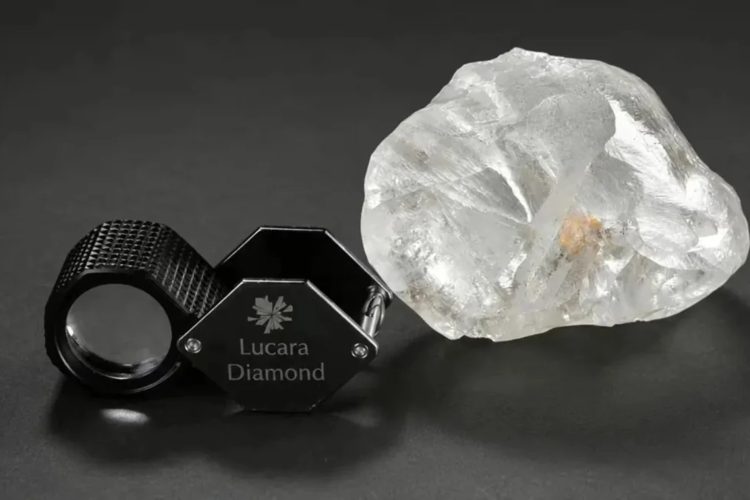
The latest proof arrived in the form of an enormous rough diamond that originally weighed 1,305.4 carats.
Measuring approximately 79.9 × 34.1 × 51.9 millimeters, the stone weighed around 261 grams before cleaning. Following processing, its official weight was adjusted to 1,303 carats.
Far more important than the 2.4 carats it lost is its classification: Lucara describes it as a D-color, Type IIa white diamond.
D color represents the highest grade on the standard diamond color scale, while Type IIa denotes exceptionally chemically pure diamonds containing very little nitrogen. Some of the world’s most famous and valuable diamonds belong to this rare category.
The new stone is the tenth diamond weighing more than 1,000 carats that Karowe has produced in less than 15 years of operation, and Lucara claims that no other mine in history has achieved such a result.
And remarkably, this is not even the largest diamond found here.
At This Mine, 1,303 Carats Is Only Good Enough for Fifth Place
The latest giant ranks fifth among the largest rough diamonds ever recovered from Karowe.
At the top of the list is Motswedi, which weighed 2,492 carats when it was discovered in 2024 and 2,488 carats after cleaning. Other spectacular discoveries include a 2,036-carat diamond, the famous 1,758-carat Sewelô and another stone weighing 1,476 carats.
And this is where the story becomes particularly uncomfortable for the mine’s former owner.
The problem may not have been that enormous diamonds were absent, but rather that the technology available at the time was not good enough to detect them – or necessarily capable of recovering them from the ore without damaging them.
$50 Million Worth of Technology Changed Everything
Lucara invested between $50 million and $60 million in upgrading the processing plant and introducing advanced X-ray Transmission, or XRT, technology.
Rather than relying exclusively on traditional processing methods, the XRT system uses the X-ray characteristics of materials to identify diamonds within the ore. For a mine like Karowe, this proved crucial, as it allows extremely large stones to be identified early and reduces the risk of them being broken during processing.
And the investment demonstrated its value with almost cinematic speed.
During the very first weekend after the system became operational in 2015, a 269-carat diamond was recovered.
That stone was later sold for approximately $20 million.
In other words, a single diamond discovered almost immediately after the introduction of the new technology recovered a significant portion of the investment in the entire system.
And then the giants started arriving.
De Beers Saw a Problem, Lucara Saw an Opportunity
That is why the history of Karowe today looks almost like a business nightmare for De Beers.
The company discovered the deposit, analyzed it and concluded that its economic potential was not sufficiently attractive. Lucara then took over the project, invested in technology tailored to the specific characteristics of the ore and transformed Karowe into one of the world’s most famous sources of exceptionally large diamonds.
Of course, it would be too simplistic to say that De Beers “sold billions for $49 million.” Developing a mine requires enormous investment, while the XRT sorting capabilities available today did not exist in the same form when the deposit was originally evaluated.
But from today’s perspective, it is difficult to imagine a better example of just how expensive an incorrect assessment of a resource’s potential can become.
The Best May Still Be Yet to Come
The Karowe story is far from over.
Open-pit mining is expected to conclude during the fourth quarter of 2026, after which the focus will shift to the underground portion of the deposit.
Full underground production capacity is planned for the first half of 2028, targeting precisely the most valuable areas of the Karowe orebody.
If the mine’s history so far is any indication, its list of diamonds weighing more than 1,000 carats may not stop at ten.
There is also a charming irony in its name. Karowe means “precious stone” in the local Sesarwa language – a name chosen long before the mine began producing some of the largest diamonds of the modern era.
This time, the name proved far more accurate than the original geological assessments.