


More photos
Urwerk has never made watches for those who want to go unnoticed, but the UR-1001 Amadeus pushes even the brand’s standards of eccentricity to a new level.
The enormous titanium pocket watch has been hand-engraved for approximately 500 hours, features elaborate Baroque ornamentation inspired by Wolfgang Amadeus Mozart and houses a mechanism capable of tracking seconds, days, years, centuries – and even an entire millennium. The price of this unique horological experiment? An impressive $561,000.
If there is one manufacture capable of creating a mechanical watch with a 1,000-year indicator and somehow making the idea seem perfectly logical, it is Urwerk.
For decades, the independent Swiss brand has rejected almost every traditional rule of watch design. Instead of conventional hands and round cases, there are satellite time displays, retrograde mechanisms, futuristic forms and complications that often look as though they have arrived from some science-fiction universe.
The new UR-1001 Amadeus, however, combines that futurism with something completely unexpected – lavish Baroque artistry.
A Pocket Watch That Isn’t Exactly Pocket-Sized
The Amadeus is a unique piece based on the UR-1001 Zeit Device, which Urwerk first introduced in 2011.
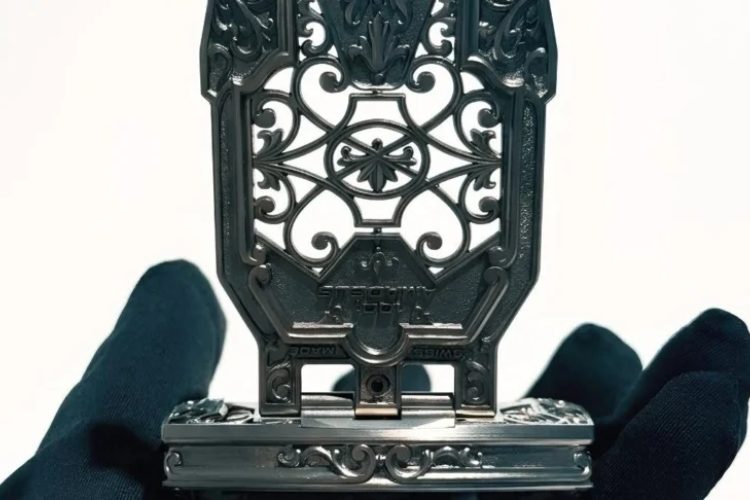
Its substantial dimensions of 106 x 62 x 23 mm immediately make it clear that this is not a conventional pocket watch designed to disappear discreetly into a jacket pocket.
But its size is only the beginning.
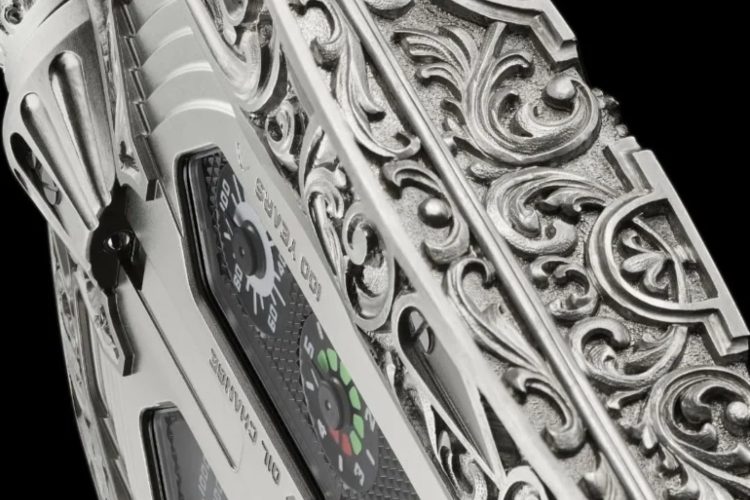
The case is crafted from titanium, while German master engraver Florian Güllert spent approximately 500 hours transforming its surface into an intricate Baroque sculpture.
Some of the material was initially removed by laser before the painstaking handwork began. By combining different depths, textures, finishes and negative space, Güllert created a surface that changes dramatically depending on the angle at which light strikes it.
It is a rather unusual contrast: the distinctly futuristic world of Urwerk has been given decoration that appears to belong to an entirely different era.
From Seconds to an Entire Millennium
If the exterior is spectacular, the mechanics are even more unusual.
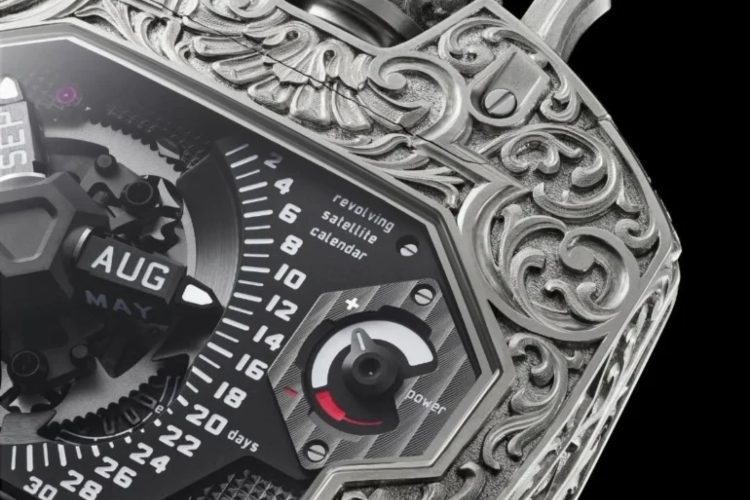
The front features Urwerk’s characteristic satellite hour display system. A retrograde minute hand moves across the scale before returning to its starting position as the next hour takes over.
Seconds are displayed by three hands covering 20-second intervals, while a separate indicator shows the transition between day and night.
There is also a sophisticated annual calendar displaying the date and month, mechanically recognizing months with 28, 30 and 31 days.
A power reserve indicator reveals how much remains of the total 39 hours of autonomy.
And all of this is found on just one side of the watch.
Turn It Over – and the Journey Through the Centuries Begins
The back of the UR-1001 Amadeus reveals why this watch becomes much more than an eccentric collector’s object.
Urwerk has incorporated an oil-change indicator linked to a five-year service interval.
Beyond that is a mechanical 100-year counter, which advances in five-year increments.
And when an entire century has passed?
The mechanism moves on to a linear millennium indicator.
In other words, the UR-1001 Amadeus has been constructed to mechanically track the passage of time across 1,000 years.
Of course, the idea that the same mechanical watch will continue operating uninterrupted for the next ten centuries is more of a philosophical and horological concept than a promise to its future owner.
But that is precisely the point.
The person who buys it today will never see the end of the story their watch has begun to measure.
Why Amadeus?
The name was not chosen by accident.
Amadeus is a tribute to Wolfgang Amadeus Mozart, while Urwerk co-founder Felix Baumgartner has described the legendary composer as an avant-gardist and a brilliant madman.
It is difficult to imagine a more appropriate inspiration for this watch.
Mozart pushed the boundaries of the music of his time, while Urwerk has spent years attempting to do something similar with the traditional concept of the mechanical watch.
The Baroque ornamentation further emphasizes that connection, but without attempting to transform the UR-1001 into a historical replica. Beneath the elaborate hand engraving remains an unmistakably modern and experimental machine.
UR-10.01 With 51 Jewels
The UR-1001 Amadeus is powered by Urwerk’s automatic UR-10.01 movement.
It operates at a frequency of 4 Hz, features 51 jewels and provides a 39-hour power reserve. It uses a unidirectional automatic winding system and a Swiss lever escapement, while the plates and bridges are treated with a combination of technical and decorative finishing techniques.
Yet even these impressive specifications almost become secondary to the concept of the watch itself.
The UR-1001 Amadeus simultaneously tracks units of time on such radically different scales that they become almost absurd.
The seconds hand races continuously.
The year counter will move incomparably more slowly.
And the millennium scale remains practically motionless in relation to a human lifetime.
$561,000 for a Watch That Will Outlive You
The price of this one-of-a-kind piece is $561,000.
That makes the UR-1001 Amadeus an object intended for an extremely small circle of collectors, although practicality was never really the point here.
Even the term “pocket watch” feels slightly comical when the object measures more than ten centimeters and costs as much as a substantial piece of real estate.
The Amadeus is better understood as a mechanical sculpture about the very nature of time.
Its owner can watch the seconds disappear before their eyes, knowing that inside the same case sits an indicator whose end will not be witnessed by their children, grandchildren or dozens of generations that come after them.
In the world of luxury watches, where people often speak of objects being “passed down to future generations,” Urwerk has taken that phrase almost terrifyingly literally.