



More photos
Swiss watchmaking manufacture Patek Philippe pays tribute to Milan in spectacular fashion, unveiling two exceptional timepieces that combine the art of miniature enameling, sophisticated mechanics, and one of the most complex complications in haute horlogerie. The World Time Minute Repeater 5531G-012 and 5531G-013, crafted from 18-karat white gold, depict Milan by day and by night, while their extraordinary movements allow the local time in a selected world city to be not only seen but also heard. Each version is limited to just five pieces worldwide.
When one of Switzerland's most prestigious watchmaking houses decides to honor one of Europe's most influential cities, the result is unlikely to be an ordinary watch.
The Patek Philippe World Time Minute Repeater Milano 2026 represents an extraordinary combination of artisanal craftsmanship, technical virtuosity, and artistic interpretation of an urban landscape, transforming an entire city into a miniature composition worn on the wrist.
Unveiled for the Watch Art Grand Exhibition Milan 2026, the new models celebrate Italy's capital of fashion and design while honoring Patek Philippe's longstanding relationship with Italian collectors.
Their exceptional character lies in the combination of two prestigious horological complications: a world-time display based on the tradition of legendary watchmaker Louis Cottier and a minute repeater capable of acoustically indicating the local time in a selected time zone.
Milan by Day and Night: Two Faces of an Extraordinary City
The two exclusive models offer different interpretations of the same city, using color, light, and miniature architectural details to capture its distinctive character.
The Patek Philippe 5531G-012, the daytime edition, presents an aerial view of central Milan.
At the heart of the composition stands the famous Milan Cathedral, the Duomo, surrounded by an intricate network of streets, buildings, rooftops, and green spaces.
Rather than depicting a conventional city panorama, the watch reveals a complex urban landscape rendered in delicate shades of cream, terracotta, pale red, and green.
The result resembles an architectural miniature, capturing the richness and visual complexity of the Italian metropolis.
Creating this extraordinary dial required approximately 45 centimeters of exceptionally fine gold wire, weighing just 0.15 grams, along with 16 different enamel shades.
The second version, Patek Philippe 5531G-013, portrays Milan at night.
Its composition uses 12 enamel colors to create an entirely different atmosphere, transforming the familiar urban landscape into a sophisticated nocturnal scene.
Both models are surrounded by a ring displaying the names of 24 world cities in Italian, with Milan highlighted in red.
An additional 24-hour ring makes it possible to distinguish between daytime and nighttime hours across the various time zones.
Together, these details transform the dials into miniature works of art that celebrate Milan's architectural identity while maintaining the exceptional functionality expected from Patek Philippe.
A Watch That Doesn't Just Display Time—It Chimes It
The most remarkable feature of these timepieces lies within their extraordinarily sophisticated mechanical systems.
The World Time Minute Repeater combines the display of time across 24 time zones with a minute repeater, a complication that uses audible chimes to indicate the hours, quarter-hours, and minutes.
In the Patek Philippe 5531, these two functions are connected in a particularly ingenious way.
By pressing the button positioned at 2 o'clock, the wearer can change the selected time zone, advancing the city display in one-hour increments.
When the minute repeater slide on the left side of the case is activated, the watch acoustically indicates the local time of the city positioned at 12 o'clock.
The system uses different tones to communicate the time.
Low-pitched strikes represent the hours, alternating high- and low-pitched double chimes indicate the quarter-hours, and high-pitched strikes announce the remaining minutes.
For example, if the local time is 5:37, the movement will produce five low-pitched strikes, two double chimes for the completed quarter-hours, and seven high-pitched strikes for the remaining minutes.
A dedicated safety mechanism automatically prevents time-zone adjustments while the minute repeater is operating, protecting the movement's exceptionally delicate components.
This ability to acoustically reproduce the time in a selected world city represents one of the rarest and most sophisticated functions in contemporary watchmaking.
It also demonstrates the extraordinary engineering expertise required to integrate two complex complications into a single mechanical movement.
Caliber R 27 HU: A Mechanical Heart with 452 Components
Both models are powered by the self-winding Patek Philippe Caliber R 27 HU, a movement representing an exceptional achievement in precision watchmaking.
Measuring 32 millimeters in diameter and just 8.5 millimeters thick, this intricate mechanism contains an impressive 452 components and 45 jewels.
Its technical specifications include a Gyromax balance, a Spiromax balance spring made from Silinvar, and a miniature 22-karat gold rotor decorated with traditional guilloché engraving.
The movement operates at a frequency of 21,600 vibrations per hour and provides a power reserve of approximately 43 to 48 hours.
Particular attention has been devoted to the acoustics of the minute repeater.
Its two gongs are attached directly to the caseband rather than the movement's mainplate, improving sound transmission and enhancing the clarity of the chimes.
Patek Philippe also continues one of its most celebrated traditions: Thierry Stern, the company's president, personally listens to and approves the sound of every minute repeater before it is delivered to its owner.
This meticulous procedure illustrates just how important acoustic quality remains in the world of the most prestigious mechanical timepieces.
For Patek Philippe, a minute repeater is not merely a technical complication. It is also a musical instrument whose sound must meet the manufacture's exacting standards.
The Art of Enameling: Miniature Milan Created at 850 Degrees Celsius
Although the mechanical movement is extraordinary, the creation of the dials represents an equally demanding process.
To depict Milan, Patek Philippe employed the traditional Grand Feu cloisonné enamel technique, one of the most complex decorative methods in haute horlogerie.
The process begins with the manual shaping of exceptionally fine gold wire, which is used to create tiny compartments separating the different enamel colors.
These compartments are then filled with enamel made from powdered glass, after which the dial undergoes multiple firings at temperatures of approximately 850 degrees Celsius.
Each firing carries the risk of color changes, deformation, or cracking, making the production of such dials exceptionally challenging.
The daytime version incorporates 16 different colors, while the nighttime edition uses 12 shades.
Despite their different color palettes, both dials are created using approximately the same length of gold wire.
Each also features a discreet "A.P." signature associated with the atelier of celebrated enamel artist Anita Porchet, reflecting the involvement and supervision of her workshop in these exceptional decorative creations.
The resulting cityscapes are not printed reproductions but authentic miniature artworks produced through painstaking manual craftsmanship.
Every architectural detail, subtle color transition, and carefully positioned gold partition contributes to the remarkable depth of the finished composition.
The technique demonstrates how centuries-old decorative traditions continue to play a vital role in contemporary luxury watchmaking.
White Gold Cases and Details Worthy of Haute Horlogerie
Both timepieces are crafted from 18-karat white gold, with cases measuring 40.2 millimeters in diameter and approximately 47.35 millimeters from lug to lug.
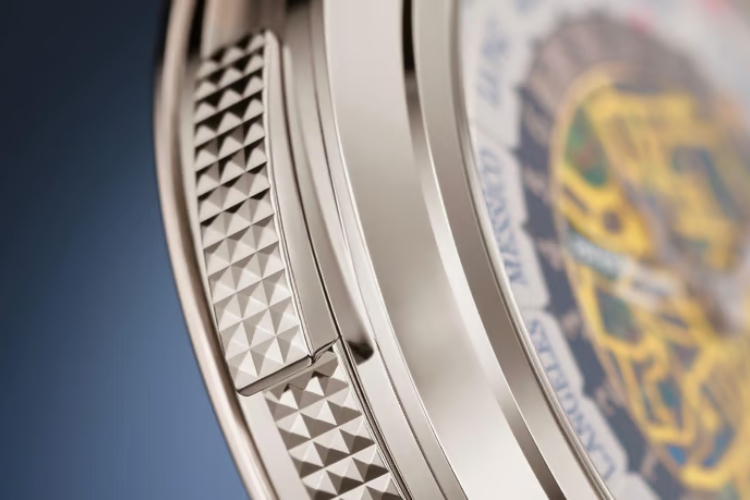
The casebands and minute repeater slides feature hand-executed Clous de Paris guilloché decoration, which extends between the skeletonized lugs.
The hands are equally distinctive.
The hour hand features an openworked design inspired by the Southern Cross constellation, while the minute hand adopts an elegant elongated diamond shape.
The daytime 5531G-012 is paired with a hand-stitched light brown calfskin strap featuring a pronounced texture and cream-colored stitching.
The nighttime 5531G-013 comes with a midnight-blue calfskin strap accented by contrasting red stitching.
Both models feature white gold fold-over clasps and two interchangeable casebacks: one made from sapphire crystal, allowing the wearer to admire the movement, and another crafted from solid white gold.
Both casebacks bear the engraving "Patek Philippe Milano 2026," further emphasizing the watches' collectible significance.
These carefully considered details ensure that the artistry extends beyond the dials to every visible aspect of the timepieces.
Milan as an Inspiration for Exceptional Watchmaking
The decision to celebrate Milan through these extraordinary watches is no coincidence.
Italy has occupied an important place in Patek Philippe's history for decades, while Italian collectors and retailers have played a significant role in shaping the culture of luxury watch collecting.
Thierry Stern has recalled advice from his father, who told him that a watch appreciated by Italians would almost certainly find success in other markets as well.
As an international center of fashion, architecture, furniture design, and luxury craftsmanship, Milan provides a natural setting for timepieces that combine mechanical precision with artistic expression.
The Watch Art Grand Exhibition Milan 2026 takes place at CityOval, within the former Palazzo delle Scintille building.
The exhibition occupies approximately 2,900 square meters beneath an impressive dome rising around 30 meters high.
It features 15 thematic sections and approximately 500 watches and other exhibits, offering visitors an extensive exploration of Patek Philippe's heritage and craftsmanship.
Within this setting, the World Time Minute Repeater Milano 2026 models stand among the most compelling examples of the relationship between traditional watchmaking and contemporary creativity.
Their intricate depictions of the city create a particularly meaningful connection between the exhibition's location and the artistic identity of the watches themselves.
Just Ten Watches and a Price of $874,200
The exclusivity of the new models is further emphasized by their extraordinarily limited production.
The Patek Philippe 5531G-012 and 5531G-013 will each be produced in just five examples, meaning the entire Milano 2026 collection comprises only ten watches.
The official US price of the daytime 5531G-012 is $874,200, placing it among the most exclusive contemporary creations from Patek Philippe.
Interestingly, despite their ability to display time across 24 world time zones, these watches do not feature a declared water-resistance rating.
The manufacturer specifies protection against moisture and dust only, highlighting the fact that these are exceptionally delicate mechanical works of art rather than sports watches intended for demanding conditions.
For collectors, their appeal lies in the combination of extreme rarity, extraordinary craftsmanship, mechanical complexity, and the artistic significance of their Milan-inspired dials.
The Patek Philippe World Time Minute Repeater Milano 2026 represents far more than an expensive luxury watch.
It is a miniature portrait of a city, a testament to exceptional artisanal skill, and a mechanical masterpiece that transforms time into sound.
In a world where exceptional watches are increasingly regarded as collectible works of art, these two models offer a remarkable demonstration of the philosophy that has defined Patek Philippe for generations: a harmonious combination of tradition, innovation, and timeless elegance.